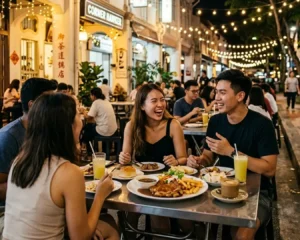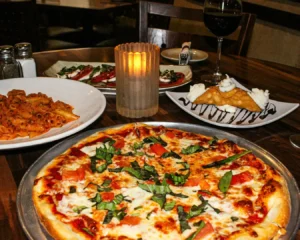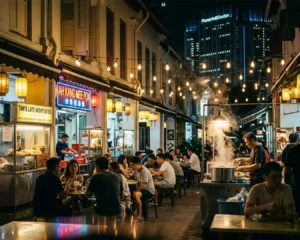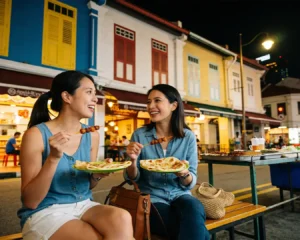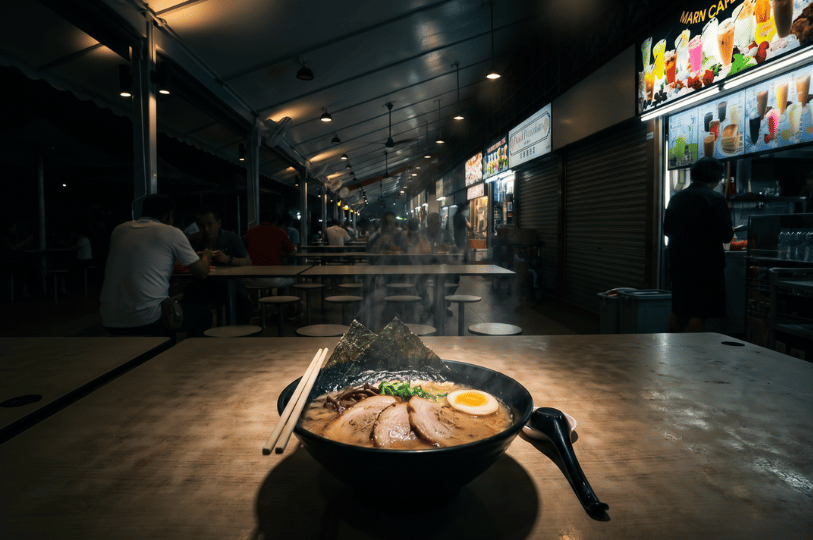
The first time I tried to photograph a bowl of noodles in the dark, I lost.
I was at a supper stall past midnight, fiddling with settings, raising the brightness, fighting the shadows like they were the enemy. By the time I got a clean shot, the broth had gone tepid and the moment had passed.
I learned something that night. The darkness was never the problem. My need to erase it was.
Let the Dark Stay Dark
For a long time, I thought good food photography meant even light. Soft, generous, flattering. The kind you find in bright cafés where everything looks gentle.
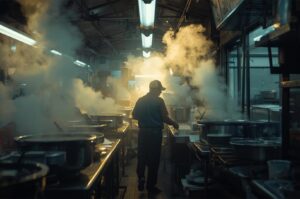
But the night doesn’t work that way. The night gives you a single bulb over a wok, a smear of neon on a wet pavement, a fluorescent tube buzzing over steel trays.
So I stopped fighting it.
At Newton Food Centre, I once shot a plate of sambal stingray lit by nothing but the stall’s hanging bulb. The chilli caught the light and glowed. Everything around it fell into shadow. The darkness held the dish like cupped hands, and the photo said more than any bright frame ever could.
That is the trick I keep relearning. You don’t illuminate the whole scene. You find the one light the night already offers, and you let it do the work.
Reading the Light You’re Given
Every stall has its own light. Part of the joy is learning to read it.
The harsh overhead tube at a zi char stall makes broth shine like glass. Catch it at the right angle and the surface turns into a mirror. At Maxwell Food Centre, the warm glow over the chicken rice counter wraps everything in amber, and the steam rising off the trays becomes the softest part of the frame.
Then there’s fire. At an Old Airport Road Food Centre wok stall, the flame is your light source, fast and gold and gone in a second. You don’t control it. You wait for it. You let the burst decide your exposure, and you accept that some frames will be too dark and some just right.
I’ve come to love that lack of control. The night humbles you. It reminds you that you are a guest at someone else’s table, not the one in charge.
I’ve come to love that lack of control. The night humbles you. It reminds you that you are a guest at someone else’s table, not the one in charge.
The People in the Shadows
What stays with me, long after the photos, is who I meet in that low light.
The uncle at a prawn noodle stall who slid an extra prawn into my bowl without a word. The auntie who waved me closer so I could catch her wok flare at its brightest, then went back to her work like nothing happened.
Late-night food has a way of softening strangers. The day crowd is gone. What’s left is the night-shift workers, the after-drinks crews, the solo diners hunched over a single bowl, and the people who feed all of them while the city sleeps.
I once shared a counter with two strangers over bak kut teh. We barely spoke the same language. Still, they showed me how to dip the dough fritters into the peppery soup, and for twenty minutes we were not strangers at all.
I photographed their hands, not their faces. The light was too dim for anything sharp. But the warmth came through anyway, the way it always does when you stop chasing perfection.
What the Dark Keeps Teaching Me
I no longer carry extra lights to these places. It feels like arriving at someone’s home and rearranging their furniture.
Instead, I bring patience. I let the bulb flicker, the neon bleed, the shadows swallow the edges. I trust that the feeling will survive even when the details don’t.
Maybe that’s the real lesson of shooting after dark. You stop trying to make the night behave. You let it stay mysterious, a little unresolved, and you find your subject inside it rather than on top of it.
So I keep going back, into the steam and the dim and the hum of late stalls, waiting to see what one small light will reveal next.

Western Food in SG at the Table: Familiar Dishes Seen Slowly
Sarah Teh | April 8, 2026
I often photograph western food in sg the same way I approach a new street. I arrive without expectation and stay long enough to notice what does not change. Western food in Singapore has a particular steadiness to it. It is not chasing attention. It is waiting to be recognized. These meals are rarely dramatic….
-
Western Food In Singapore After Dark: A Midnight Photographer’s View
Sarah Teh | April 1, 2026
I often find myself photographing western food late at night, when the city softens and the dining table becomes quieter. Western food in Singapore does not always live inside polished restaurants. Sometimes it sits under fluorescent lights at a food center, sometimes at a hawker stall with a flat top grill that has seen decades…
-
The Art of Night Dining Photography: Tanjong Pagar Food
Sarah Teh | March 25, 2026
It’s close to midnight when the CBD quiets and Tanjong Pagar’s corridor lights ignite with warmth. The late MRT ride is the threshold to a world where tanjong pagar dining scenes unfold for my camera—tanjong pagar food under neon and rain-polished streets, kitchens humming long past regular opening hours. The tanjong pagar area stands out…
-
Chinatown Food in Singapore: A Photographer’s Guide to Street Food After Sunset
Sarah Teh | March 18, 2026
You step off the train, and the humidity hits you first, closely followed by the intoxicating aroma of sizzling garlic, roasting meats, and sweet soy sauce. The sun dips below the horizon, and neon signs flicker to life, casting a warm red glow over the bustling streets. Arriving hungry here is an absolute necessity to…
-
Tanjong Beach Club Singapore: Photographic Rhythm on Sand, Sea, and Night Service
Sarah Teh | March 11, 2026
The sun stretches along Tanjong Beach, casting shifting gold onto the sand and across plush daybeds that define this corner of Singapore’s beach culture. This is golden hour at Tanjong Beach Club, often regarded as one of Singapore’s best beach destinations, where the world outside the city softens, welcoming guests who discover their own spot…
-
What to Eat in Tanjong Pagar: Night Photography Across Best Restaurants, Food Centres, and Modern Eateries
Sarah Teh | March 4, 2026
I arrive inTanjong Pagar as blue hour overtakes the shophouse spine. The goal isn’t just dinner—it’s to answer what to eat in Tanjong Pagar from a night photographer’s field standpoint. Every dish and space signals an opportunity, from fried chicken to glossy rice bowls, all set in dynamic, real service. What matters is resonance under…
-
Food in Tanjong Pagar: A Midnight Photographer’s Field View to Food & Light After Dark
Sarah Teh | February 25, 2026
When Singapore’s CBD finally exhales, and the bustle of the day quiets around Tanjong Pagar MRT station, the lights come up on a different stage. Here, in the heart of Tanjong Pagar, hidden food centres, bustling hawker stalls, and stylish Korean and Japanese restaurants located in Tanjong Pagar keep the neighbourhood’s energy burning late. Whether…

Unveiling Hidden Treasures: An Enchanting Evening at Chijmes Restaurant
Sarah Teh | February 18, 2026
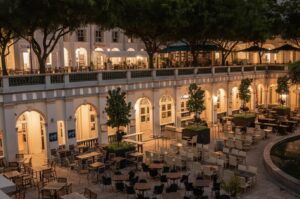
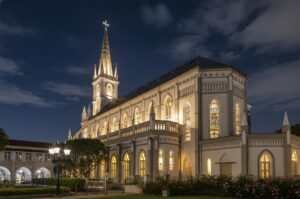
As night spills over the cloisters of CHIJMES, the bustle from Victoria Street fades to a hum and the architectural bones of the historic convent emerge, lit by warm lamps and candlelight. I arrive late, just as the last light fades, hunting for the perfect chijmes restaurant frame; one that balances cultural heritage conservation with…
-
CHIJMES Singapore: Photographing Heritage, Dining, and Architectural Icons
Sarah Teh | February 12, 2026
When I first visited CHIJMES Singapore, I was immediately captivated by how seamlessly history and modern life blend here. I practically had to restrain myself from pointing my lens at everything my eyes land on. Nestled at the bustling intersection of Victoria Street, North Bridge Road, and Bras Basah Road, this national monument and historic…
-
Before the Rush: Capturing the Hidden Rhythms of Amoy Food Centre Photography
Sarah Teh | February 4, 2026
Dawn at Amoy Street Food Centre is a collision of fluorescent lights and billows of steam. Against tiled grates, condensation slides down; hawkers prime their pepper bowl and swirl strands of sliced fish soup through scalding water. Within this storied food centre, every corridor concentrates urgency, flavor, and visual drama. Amoy food centre photography thrives…