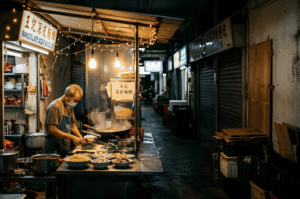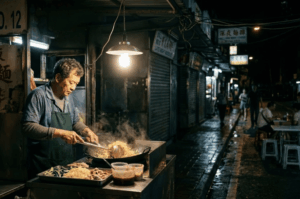
There is a half second at a wok stall that I have learned to live for. The flame leaps, the hand tilts, and the whole dish hangs in the air before it falls back into the pan. Miss it, and you get a flat plate of noodles. Catch it, and you get the night itself, mid-breath.
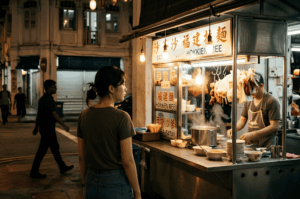
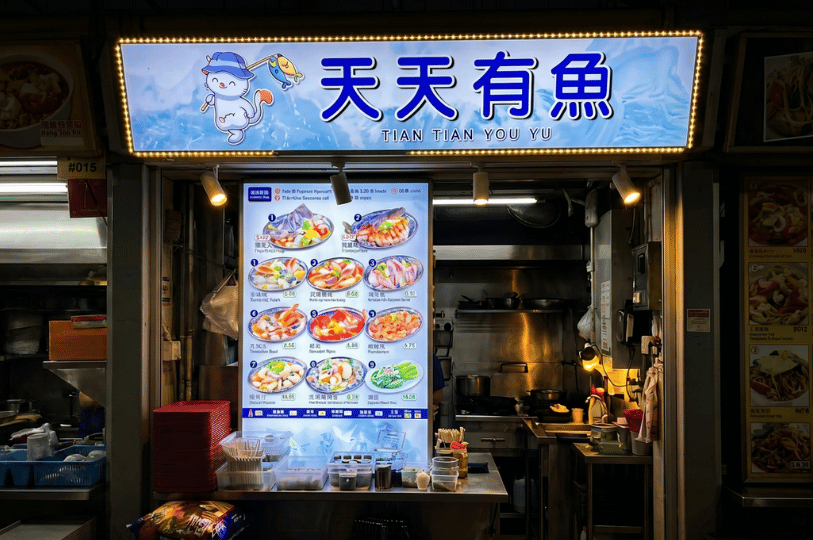
I learned this the hard way at Tian Tian Fried Hokkien Mee in Old Airport Road Food Centre. The first dozen frames were useless. I kept shooting after the action, when the prawns had already settled and the steam had thinned. Then I stopped looking at the food and started watching the cook’s shoulders instead. His body told me when the toss was coming, a half beat before his wrist moved.
The Art of Waiting
That is the strange truth of action photography at night. Most of it is stillness. You wait, finger hovering, breath held, while nothing happens. The tension lives in that gap between anticipation and release.
At a satay stall near Lau Pa Sat, I once spent twenty minutes waiting for a single gesture. The uncle turned his skewers in a slow rhythm, smoke curling around the embers, and I wanted the exact moment the fat caught fire. When it finally flared, I almost forgot to press the shutter. The light was gone in an instant, gold and then dark again.
Over at a porridge stall in Chinatown Complex, the action was quieter but no less precise. The auntie lifted her ladle high, letting the congee fall in a long thread, and I realized motion does not always mean fire and noise. Sometimes it is a single pour, a thread of steam, a pair of chopsticks lifting noodles just clear of the bowl.
The People Behind the Gesture
What moves me most is that these gestures are never performances. They are decades of muscle memory, repeated thousands of times by hands that have stopped thinking about them. The cook does not pose for me. He simply works, and I am lucky enough to be there with a lens.
At a bak chor mee counter one late night, the hawker noticed me waiting and slowed his toss, just slightly, so I could catch it. He said nothing. He just gave me the moment, then went back to his rhythm. That small generosity stayed with me longer than the photo did.
I think this is what action photography really captures. Not the food, not even the motion, but the quiet pact between the person making the meal and the person trying to honor it. We meet in that split second, and then it passes.
Holding the Breath
So I keep returning to these stalls, finger ready, eyes on the shoulders and the wrists and the smoke. I have learned that the tension is the point. The waiting is not wasted time. It is the part where you fall in love with the work again.
Maybe the perfect frame is not the goal at all. Maybe it is just an excuse to stand close to someone’s craft and feel the moment build, again and again, until the city hands you something worth keeping.

Capturing the Unseen
Sarah Teh | May 8, 2026
The Stories of Street Vendors After Dark The streets of Singapore, when the sun dips below the horizon, become a different world. The bustle of the daytime crowds fades into the background, replaced by the quiet hum of neon lights and the sizzle of food on the grill. For me, the real magic happens after…
-
Under the Shadows
Sarah Teh | May 7, 2026
Finding Beauty in the Quiet Corners of Nightlife The city at night is a different world. It’s not the constant hum of the day; instead, it’s a slower rhythm, a quiet hum that somehow feels louder in the darkness. The neon signs flicker, casting an almost magical glow over the streets, while the food stalls…
-
Geylang Food: A Nighttime Culinary Adventure in Singapore
Sarah Teh | May 6, 2026
The first time I visited Geylang for supper after dark, I was a wide-eyed tourist chasing a recommendation for the best beef kway teow. I got off at the MRT and walked into a vibrant, chaotic world of neon signs, sizzling woks, and streets humming with an energy unique to Geylang food culture. It was…
-
Chasing the Neon Glow
Sarah Teh | May 1, 2026
How Artificial Lighting Transforms Food Photography As the city slips into the quiet of night, the world around me begins to glow in neon hues. Walking through Singapore’s vibrant street food scene, I can’t help but marvel at how artificial lighting breathes life into the food I photograph. It isn’t just the food; it’s the…
-
The Magic of Night Markets
Sarah Teh | April 30, 2026
Capturing the Soul of Singapore’s Street Food As the city fades into the embrace of night, the streets of Singapore come alive with the hum of food stalls, the sizzle of woks, and the inviting glow of neon signs. The night market, or pasar malam, is more than just a place to grab a quick…
-
Wok Hei and Fluorescence: Shooting Geylang Food After Dark
Sarah Teh | April 29, 2026
My first time taking a camera to Geylang at night was a lesson in humility. I had this grand idea of capturing the “gritty authenticity” of a late-night supper. I stood over a bubbling pot of eminent frog porridge at a spot on Lorong 9, camera raised high, trying to frame the perfect shot. I…
-
Solace Under The Moon
Sarah Teh | April 24, 2026
What Food Crawls at Night Taught Me People tell me all the time why I, a woman, feel so comfortable going out into Singapore’s bustling streets. To be frank, I hadn’t always been this “brave”, as they say. Growing up, my family had always warned me about the dangers of the nightlife, especially in a…
-
Midnight Menus: Decoding Western Food in SG
Sarah Teh | April 22, 2026
The rain stopped an hour ago. Wet pavements reflect the steady orange glow of streetlamps across empty CBD corners. The last bus hums past a quiet row of shophouses in Tanjong Pagar, where a lone kitchen worker stacks chairs onto tables. Steam rises from a street-side grate, carrying the faint, lingering scent of charred meat…

Best Japanese Curry Singapore: Late-Night Comfort Food Rituals
Sarah Teh | April 16, 2026
The shutters pull down on the retail shops by ten. In the basement corridors of Singapore’s quiet malls, the bright overhead lights drop to a low hum. The evening rush fades, leaving behind a sparse, deliberate crowd. An office worker loosens his tie, staring at a glowing menu board. A nurse carrying a canvas tote…
-
Western Food in SG at the Table: Familiar Dishes Seen Slowly
Sarah Teh | April 8, 2026
I often photograph western food in sg the same way I approach a new street. I arrive without expectation and stay long enough to notice what does not change. Western food in Singapore has a particular steadiness to it. It is not chasing attention. It is waiting to be recognized. These meals are rarely dramatic….