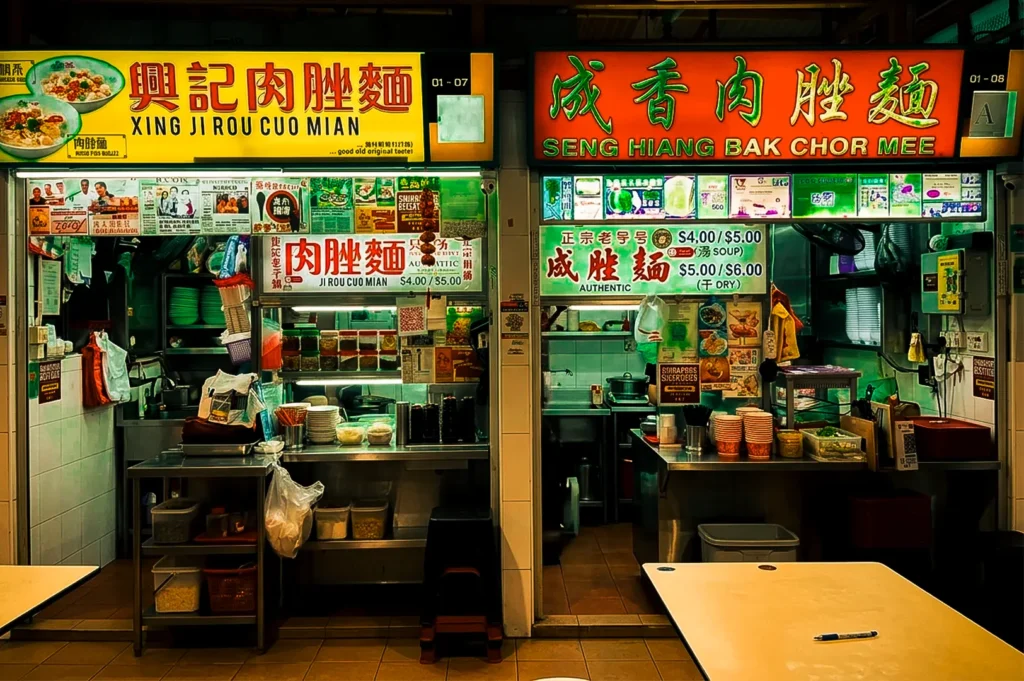
It was past ten when I got to Bedok 85, and the steam was doing all the talking.
Fong Seng was long shut by then, but the hawker centre still hummed.
A few tables of men in singlets nursing beers. The clack of a wok somewhere behind me. And that particular fluorescent glare that flattens everything it touches, spilling white and cold over plastic chairs and metal counters.
I came for two bowls. I stayed for the light.
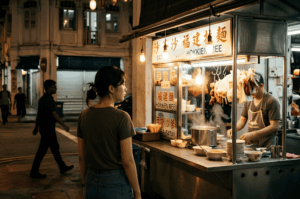
At Xing Ji Wanton Mee, the bak chor mee comes out fast. The uncle worked without looking up, blanching the noodles in a wire basket, shaking off the water in three sharp flicks. Then the vinegar. Then the chilli. His hands knew the order without thinking.
I had maybe a few seconds before the steam thinned out, so I framed low and close, letting the fluorescent tube behind him catch the sheen on the noodles.
That was the hardest part. The gravy on bak chor mee is dark and reflective, and overhead lighting turns it into a mirror. Tilt the bowl the wrong way and you get a bright white circle where the sauce should be.
So I moved. I crouched, shifted left, waited for the reflection to slide off the edge of the frame. What I wanted was texture, not shine. The minced pork, the char of the ti poh, the way the chilli pooled red at the bottom.
I got one frame I liked. The noodles still lifting a thin ribbon of steam, the vinegar catching light like glass.
Then I ate, because that is the deal. You do not let a bowl go cold for a photograph.
Seng Hiang was quieter. The porridge stall sat further in, and the light there was warmer, an older tube gone slightly yellow with age. The auntie ladled congee into a bowl, slow and steady, the rice broken down to something soft and pale. She cracked a raw egg over the top and let it slide in.
No flourish. Just the motion of someone who had done it ten thousand times.
Porridge is a difficult thing to photograph. It has no obvious shape. It sits in the bowl like a quiet grey lake, and if you are not careful it reads as nothing at all.
So I looked for the small things. The gloss of the egg yolk sinking in. A scatter of spring onion. The steam, again, always the steam, rising in a thin line under the yellow light.
I shot it from just above, close enough to lose the edge of the bowl. The warmth of that older tube did something the white light at Xing Ji could not. It made the congee feel like comfort. Like something you eat when you are tired, or unwell, or just want to be looked after for a while.
Between the two stalls, the light told two different stories. Cold and sharp at one. Soft and worn at the other. Same hawker centre, same hour, two entirely different moods sitting fifty steps apart.
That is the thing about shooting food at night here. You do not control the light. You find it. You work around the queue, the shared tables, the uncle who wants his counter back. You take what the room gives you and you make it mean something.
I left with both bowls emptied and a handful of frames I was not sure about. That happens more often than not. The best ones rarely announce themselves at the counter.
But I keep thinking about the auntie at Seng Hiang, cracking that egg without a word. How the yolk caught the light for a second before it disappeared into the rice.
Some moments you photograph. Some you just carry home.

Wok Hei and Fluorescence: Shooting Geylang Food After Dark
Sarah Teh | April 29, 2026
My first time taking a camera to Geylang at night was a lesson in humility. I had this grand idea of capturing the “gritty authenticity” of a late-night supper. I stood over a bubbling pot of eminent frog porridge at a spot on Lorong 9, camera raised high, trying to frame the perfect shot. I…
-
Solace Under The Moon
Sarah Teh | April 24, 2026
What Food Crawls at Night Taught Me People tell me all the time why I, a woman, feel so comfortable going out into Singapore’s bustling streets. To be frank, I hadn’t always been this “brave”, as they say. Growing up, my family had always warned me about the dangers of the nightlife, especially in a…
-
Midnight Menus: Decoding Western Food in SG
Sarah Teh | April 22, 2026
The rain stopped an hour ago. Wet pavements reflect the steady orange glow of streetlamps across empty CBD corners. The last bus hums past a quiet row of shophouses in Tanjong Pagar, where a lone kitchen worker stacks chairs onto tables. Steam rises from a street-side grate, carrying the faint, lingering scent of charred meat…

Best Japanese Curry Singapore: Late-Night Comfort Food Rituals
Sarah Teh | April 16, 2026
The shutters pull down on the retail shops by ten. In the basement corridors of Singapore’s quiet malls, the bright overhead lights drop to a low hum. The evening rush fades, leaving behind a sparse, deliberate crowd. An office worker loosens his tie, staring at a glowing menu board. A nurse carrying a canvas tote…
-
Western Food in SG at the Table: Familiar Dishes Seen Slowly
Sarah Teh | April 8, 2026
I often photograph western food in sg the same way I approach a new street. I arrive without expectation and stay long enough to notice what does not change. Western food in Singapore has a particular steadiness to it. It is not chasing attention. It is waiting to be recognized. These meals are rarely dramatic….
-
Western Food In Singapore After Dark: A Midnight Photographer’s View
Sarah Teh | April 1, 2026
I often find myself photographing western food late at night, when the city softens and the dining table becomes quieter. Western food in Singapore does not always live inside polished restaurants. Sometimes it sits under fluorescent lights at a food center, sometimes at a hawker stall with a flat top grill that has seen decades…
-
The Art of Night Dining Photography: Tanjong Pagar Food
Sarah Teh | March 25, 2026
It’s close to midnight when the CBD quiets and Tanjong Pagar’s corridor lights ignite with warmth. The late MRT ride is the threshold to a world where tanjong pagar dining scenes unfold for my camera—tanjong pagar food under neon and rain-polished streets, kitchens humming long past regular opening hours. The tanjong pagar area stands out…
-
Chinatown Food in Singapore: A Photographer’s Guide to Street Food After Sunset
Sarah Teh | March 18, 2026
You step off the train, and the humidity hits you first, closely followed by the intoxicating aroma of sizzling garlic, roasting meats, and sweet soy sauce. The sun dips below the horizon, and neon signs flicker to life, casting a warm red glow over the bustling streets. Arriving hungry here is an absolute necessity to…
-
Tanjong Beach Club Singapore: Photographic Rhythm on Sand, Sea, and Night Service
Sarah Teh | March 11, 2026
The sun stretches along Tanjong Beach, casting shifting gold onto the sand and across plush daybeds that define this corner of Singapore’s beach culture. This is golden hour at Tanjong Beach Club, often regarded as one of Singapore’s best beach destinations, where the world outside the city softens, welcoming guests who discover their own spot…
-
What to Eat in Tanjong Pagar: Night Photography Across Best Restaurants, Food Centres, and Modern Eateries
Sarah Teh | March 4, 2026
I arrive inTanjong Pagar as blue hour overtakes the shophouse spine. The goal isn’t just dinner—it’s to answer what to eat in Tanjong Pagar from a night photographer’s field standpoint. Every dish and space signals an opportunity, from fried chicken to glossy rice bowls, all set in dynamic, real service. What matters is resonance under…