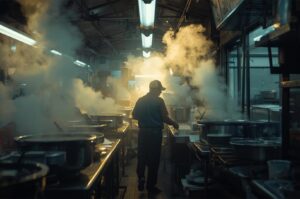
It was past ten when I got to Bedok 85, and the steam was doing all the talking.
Fong Seng was long shut by then, but the hawker centre still hummed.
A few tables of men in singlets nursing beers. The clack of a wok somewhere behind me. And that particular fluorescent glare that flattens everything it touches, spilling white and cold over plastic chairs and metal counters.
I came for two bowls. I stayed for the light.
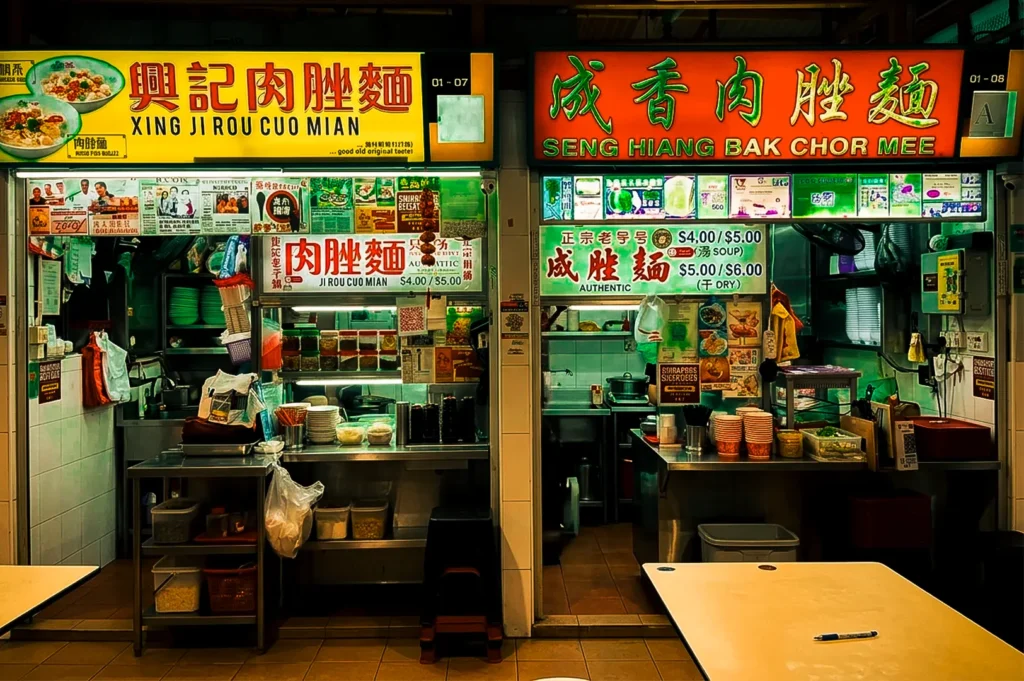
At Xing Ji Wanton Mee, the bak chor mee comes out fast. The uncle worked without looking up, blanching the noodles in a wire basket, shaking off the water in three sharp flicks. Then the vinegar. Then the chilli. His hands knew the order without thinking.
I had maybe a few seconds before the steam thinned out, so I framed low and close, letting the fluorescent tube behind him catch the sheen on the noodles.
That was the hardest part. The gravy on bak chor mee is dark and reflective, and overhead lighting turns it into a mirror. Tilt the bowl the wrong way and you get a bright white circle where the sauce should be.
So I moved. I crouched, shifted left, waited for the reflection to slide off the edge of the frame. What I wanted was texture, not shine. The minced pork, the char of the ti poh, the way the chilli pooled red at the bottom.
I got one frame I liked. The noodles still lifting a thin ribbon of steam, the vinegar catching light like glass.
Then I ate, because that is the deal. You do not let a bowl go cold for a photograph.
Seng Hiang was quieter. The porridge stall sat further in, and the light there was warmer, an older tube gone slightly yellow with age. The auntie ladled congee into a bowl, slow and steady, the rice broken down to something soft and pale. She cracked a raw egg over the top and let it slide in.
No flourish. Just the motion of someone who had done it ten thousand times.
Porridge is a difficult thing to photograph. It has no obvious shape. It sits in the bowl like a quiet grey lake, and if you are not careful it reads as nothing at all.
So I looked for the small things. The gloss of the egg yolk sinking in. A scatter of spring onion. The steam, again, always the steam, rising in a thin line under the yellow light.
I shot it from just above, close enough to lose the edge of the bowl. The warmth of that older tube did something the white light at Xing Ji could not. It made the congee feel like comfort. Like something you eat when you are tired, or unwell, or just want to be looked after for a while.
Between the two stalls, the light told two different stories. Cold and sharp at one. Soft and worn at the other. Same hawker centre, same hour, two entirely different moods sitting fifty steps apart.
That is the thing about shooting food at night here. You do not control the light. You find it. You work around the queue, the shared tables, the uncle who wants his counter back. You take what the room gives you and you make it mean something.
I left with both bowls emptied and a handful of frames I was not sure about. That happens more often than not. The best ones rarely announce themselves at the counter.
But I keep thinking about the auntie at Seng Hiang, cracking that egg without a word. How the yolk caught the light for a second before it disappeared into the rice.
Some moments you photograph. Some you just carry home.

Food in Tanjong Pagar: A Midnight Photographer’s Field View to Food & Light After Dark
Sarah Teh | February 25, 2026
When Singapore’s CBD finally exhales, and the bustle of the day quiets around Tanjong Pagar MRT station, the lights come up on a different stage. Here, in the heart of Tanjong Pagar, hidden food centres, bustling hawker stalls, and stylish Korean and Japanese restaurants located in Tanjong Pagar keep the neighbourhood’s energy burning late. Whether…

Unveiling Hidden Treasures: An Enchanting Evening at Chijmes Restaurant
Sarah Teh | February 18, 2026
As night spills over the cloisters of CHIJMES, the bustle from Victoria Street fades to a hum and the architectural bones of the historic convent emerge, lit by warm lamps and candlelight. I arrive late, just as the last light fades, hunting for the perfect chijmes restaurant frame; one that balances cultural heritage conservation with…
-
CHIJMES Singapore: Photographing Heritage, Dining, and Architectural Icons
Sarah Teh | February 12, 2026
When I first visited CHIJMES Singapore, I was immediately captivated by how seamlessly history and modern life blend here. I practically had to restrain myself from pointing my lens at everything my eyes land on. Nestled at the bustling intersection of Victoria Street, North Bridge Road, and Bras Basah Road, this national monument and historic…
-
Before the Rush: Capturing the Hidden Rhythms of Amoy Food Centre Photography
Sarah Teh | February 4, 2026
Dawn at Amoy Street Food Centre is a collision of fluorescent lights and billows of steam. Against tiled grates, condensation slides down; hawkers prime their pepper bowl and swirl strands of sliced fish soup through scalding water. Within this storied food centre, every corridor concentrates urgency, flavor, and visual drama. Amoy food centre photography thrives…
-
Amoy Street Food Centre Singapore: A Living Archive of Vanishing Culinary Techniques
Sarah Teh | January 28, 2026
As the dinner rush subsides at Amoy Street Food Centre Singapore, the true choreography begins. Seasoned hawker stall owners move with precision honed over decades, their wok fire dancing in rhythms that predate Singapore’s modern skyline. Six Michelin Bib Gourmand stalls operate within this 1983-established food centre, transforming what began as a government cleanliness initiative…
-
A Photographer’s Reference to Suntec City Photography Studios
Sarah Teh | January 21, 2026
The afternoon sun cuts through the glass canopy of Suntec City, illuminating the constant flow of shoppers and executives. In this polished world of commerce, a different kind of space exists—the photo studio. It is a controlled environment, a blank canvas waiting for a story. For a photographer or photography enthusiasts in Singapore, choosing the…
-
Photo Studio in Suntec City: Studios, City Lights, and Crafted Moments
Sarah Teh | January 14, 2026
The rain lets up, and Suntec City’s polished corridors gleam. Reflections of digital billboards shimmer on the tile floors, painting the landscape in electric blue and architectural gold. For the photographer, this part of Singapore is a world of contrasts—a space where crafted light meets the city’s pulse and every click of the shutter both…
-
Food in Joo Chiat After Midnight: Frames, Steam, and Streetlight
Sarah Teh | December 31, 2025
Joo Chiat at midnight is a vibrant stretch of color and movement. I come here not to list “food in Joo Chiat” or catalog signatures, but to watch the neighborhood build its portrait as blue hour fades beneath streetlight and neon. Every face, bowl, reflection, and plume of steam becomes part of how “Joo Chiat…
-
Joo Chiat Road Food: Traces After Dark
Sarah Teh | December 30, 2025
Opening: The Question, Reframed The search for joo chiat road food usually arrives with expectation. A food guide, a list, something mapped on Google Maps. This is not that. Joo Chiat Road runs 1.4 kilometres between Geylang Road and East Coast Road, a corridor of pre-war shophouses whose shutters lift and lower according to rhythms…
-
Plating Composition in Fine Dining: How Newly Starred Michelin Kitchens Compose a Plate
Sarah Teh | December 24, 2025
In Singapore, the journey of a newly starred Michelin restaurant begins long before the first bite. Plating in fine dining is more than decoration; it is a carefully composed arrangement that reflects the chef’s vision, the dish’s flavours, and the dining experience as a whole. Chefs in these kitchens treat each plate as a story,…