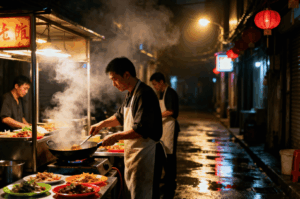
The pot never stopped moving.
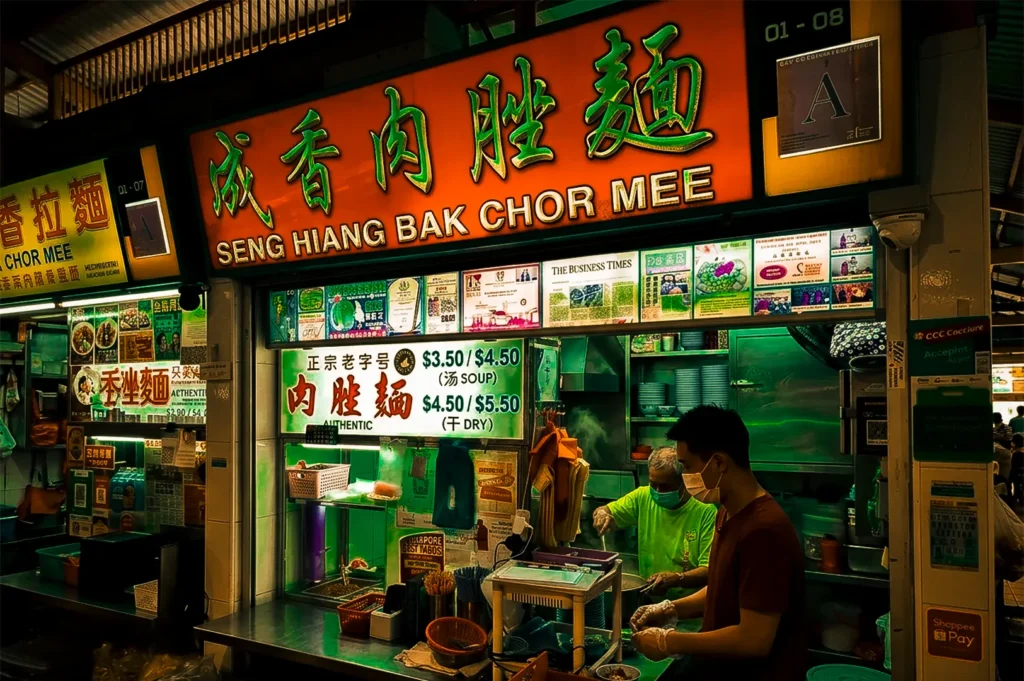
It was near midnight at Bedok 85, and I had been standing at Seng Hiang for a while, doing more watching than shooting. The auntie worked the noodles in a wire basket, dipping them into the boiling water, lifting, shaking off the drops in three quick beats. She did not look down at her hands. She did not need to. That kind of motion gets built over years, not nights.
I kept my camera low, waiting for the bowl.
Tucked within one of the most popular night markets in Singapore, the room around her was loud in the way old hawker centres get loud after midnight. A queue of four or five men in singlets, patient the way supper crowds are patient. The scrape of a stool. The clack of a ladle against metal. Somewhere behind me, a wok breathing fire. And over all of it, that flat white fluorescent light, the kind that flattens everything it touches and gives you nothing to work with.
That light was the problem.
Bare tubes overhead do no favours to a bowl of bak chor mee. The gravy underneath, dark with vinegar and chilli, turns into a mirror. Tilt the bowl one way and a hard white circle sits right where the flavour should be. I have chased that reflection at a dozen stalls and lost more frames than I have kept. It tells you nothing about the food. It just sits there, bright and empty.
So I moved.
I crouched lower, shifted a step to the side, and let the reflection slide off toward the rim and out of frame. What I wanted was texture, not shine. The minced pork. The scatter of fried lard. The way the chilli pooled red at the bottom of the bowl. The noodles still glistening, but readable, not blown out into nothing.
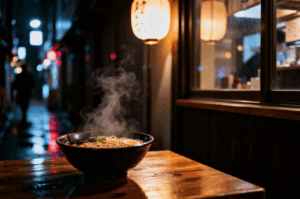
The steam was the harder thing to hold. It lifts for two seconds, maybe three, then thins into the cold air-conditioned room and is gone. You cannot ask for it back. So I framed first, set my exposure for the pale noodles, and waited with the shutter half pressed. The bowl went down. The auntie turned to the next order without a word. And for that one breath, the steam rose in a thin line under the white light, and I took the frame.
I ate after that. You do not let a bowl of bak chor mee go cold for a photograph. The vinegar had sharpened it. The lard had gone soft into the noodles. It tasted like every late night I have spent out here with a camera and an empty stomach, the kind of meal that does not go viral but stays with you anyway.
Later, scrolling through the frames, I kept returning to one I had not planned. Not the tidy overhead of the bowl. Just the auntie’s hands over the pot, half lost in steam, the basket lifting, the water still dripping in long threads back into the boil. Her face was out of focus. The queue was a blur behind her. It was not the shot I came for.
But it held the whole night in it. The heat. The waiting. The quiet, unhurried repetition of someone who has stood beside that pot longer than I have owned a camera.
That is the part of shooting food at night here that I keep learning. You come for the dish. You leave with something smaller, and truer, that you never meant to notice.
The steam is already gone by the time you see it. You just hope the frame remembers.

Best Restaurant Singapore: A Complete Guide to the Lion City’s Top Dining Destinations
Sarah Teh | December 3, 2025
Singapore is a global food capital where hawker stalls and Michelin-starred restaurants coexist, reflecting the island’s rich multicultural heritage. The city offers a vibrant culinary scene, from traditional dishes steeped in history to innovative fine dining that pushes creative boundaries. Whether you’re a local or a traveler, this guide will help you discover the best…
-
Best Dining Experiences in Singapore: The Coolest Restaurants Right Now – Scene, Substance, and Stories Behind the Plates
Sarah Teh | November 26, 2025
What makes a restaurant truly cool in Singapore? It’s more than hype-it’s about story, substance, and scene coming together. Singapore stands out as one of the top cities for diverse and affordable dining experiences, thanks to its vibrant food scene and dynamic neighborhoods. The city’s coolest restaurants offer a unique dining experience where every detail-from…
-
The Art of Waiting: Chef Portraits Photography
Sarah Teh | November 19, 2025
The kitchen closes. The last server clocks out, and the dining room succumbs to a deep, restful silence. As a photographer who specializes in capturing culinary scenes after dark, I’ve learned that the most profound moments don’t happen during the frantic pace of service. They unfold in the quiet hours that follow, when a chef…
-
Shadow Play: Using Contrast for Dramatic Food Photography
Sarah Teh | November 12, 2025
Most food photographers chase the light. They seek bright, airy scenes with soft, even illumination to make food look fresh and appealing. But after the sun goes down, or on a dark and moody day, a different kind of magic emerges. I’ve learned to stop chasing bright light and start embracing the darkness. The secret…
-
Midnight Food Photography: The Secret Life of Restaurant Kitchens After Closing
Sarah Teh | November 5, 2025
The final customer has paid their bill and walked out into the night. The clatter of dishes fades, the front doors are locked, and a deep quiet settles over the restaurant. For most, this is the end of the day. For me, this is when the real work begins. My type of photography isn’t about…
-
Midnight Tapas: Barcelona’s Hidden Late-Hour Street Food Culinary Gems
Sarah Teh | October 29, 2025
The city of Barcelona breathes differently after midnight. The relentless energy of La Rambla softens to a murmur, and the ancient lanes of the Gothic Quarter trade crowds for shadows. This is when the true life of the city reveals itself, not in grand pronouncements, but in the clinking of a glass and the shared…
-
Flame Photography Techniques: Light Painting with Kitchen Flames – A Midnight Photographer’s Technical Guide
Sarah Teh | October 22, 2025
There is a raw, untamed energy in a kitchen at full tilt. For those of us who practice food photography, the most captivating element is often the most dangerous: fire. A burst of flame from a wok or the steady burn of candles on a dining table is more than just part of the cooking…
-
After Midnight: MRT Adventures of a Food Photographer
Sarah Teh | October 17, 2025
When the clock strikes midnight in Singapore, most tourists retreat to their hotels, but for me, that’s when the real culinary adventure begins. Armed with my camera and an EZ-link card, I transform Singapore’s Mass Rapid Transit (MRT) system into my personal food photography highway, connecting me to hidden midnight eateries that only locals know…
-
The Art of Artificial Lighting for Food Photography: Creating Natural-Looking Photos After Dark
Sarah Teh | October 15, 2025
There’s a certain magic to shooting food after the sun goes down. Whether it’s a steaming bowl of ramen in a dimly lit Tokyo alley or a decadent dessert under the soft glow of a restaurant’s pendant lights, these scenes have a moodiness that daylight often lacks. But as a photographer who spends a lot…
-
Singapore Hidden Food Gems: Whispers from the Wok’s Night Kitchens
Sarah Teh | October 10, 2025
The city-state sleeps, but its heart still beats. Here at 3AM, Singapore transforms. The day’s relentless pace dissolves into a humid, quiet hum. The air, thick with the scent of night-blooming jasmine and rain-washed asphalt, carries a different kind of promise. This is when I begin my hunt, guided not by maps, but by whispers…