The dough was already folded by the time I found focus.
I had been watching the griddle for less than a minute. A man at the front of the shop stretched a sheet of dough so thin the light passed through it, he laid it flat on the hot iron and spooned the filling into the centre. Minced meat, egg, onion. Then his hands moved, four corners in, one press of the palm, and the murtabak became a square. My shutter clicked on the empty space where his fingers had been.
I lowered the camera and kept watching.
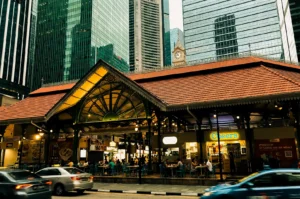
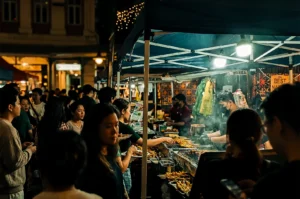
Zam Zam sits at 697-699 North Bridge Road, on a corner in Kampong Glam. At night the shopfront is lit by fluorescent tubes. The light spills onto the five-foot way and stops at the edge of the road. Check our other article if you want to know the tips and tricks on how to capture captivating food photos under the fluorescent light.
Behind me, at the end of the street, the dome of Sultan Mosque held its own quiet glow against the dark. Inside, the tables were close together. Families leaned over shared plates. Someone tore a piece of murtabak and dipped it into a small bowl of curry. Plates came out steadily, and the griddle at the front never seemed to cool.
The problem was speed.
Murtabak is made in a rhythm that does not wait for anyone. The stretch, the fill, the fold and the press happen almost as one motion. By the time I raised the lens, the moment I wanted was already folded inside the next one. Under the flat fluorescent light, my early frames showed only blurred hands and a pale smear of dough.
So I stopped chasing the fold.
I studied the pattern instead. After each fold came a short pause. The murtabak rested on the griddle, and the man pressed it down with a flat spatula, turning it once, then again. Those few seconds were slower. The crust had time to darken. Oil gathered at the edges and caught the light.
I moved to the side of the griddle, out of his way, and set my focus on the iron surface before the next order began. I lowered the camera until the griddle sat almost level with the lens. From there, the overhead light skimmed across the oil instead of flattening it. The sheen became a thin, bright line along the edge of the frame.
Then I waited for the press.
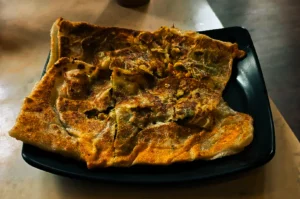
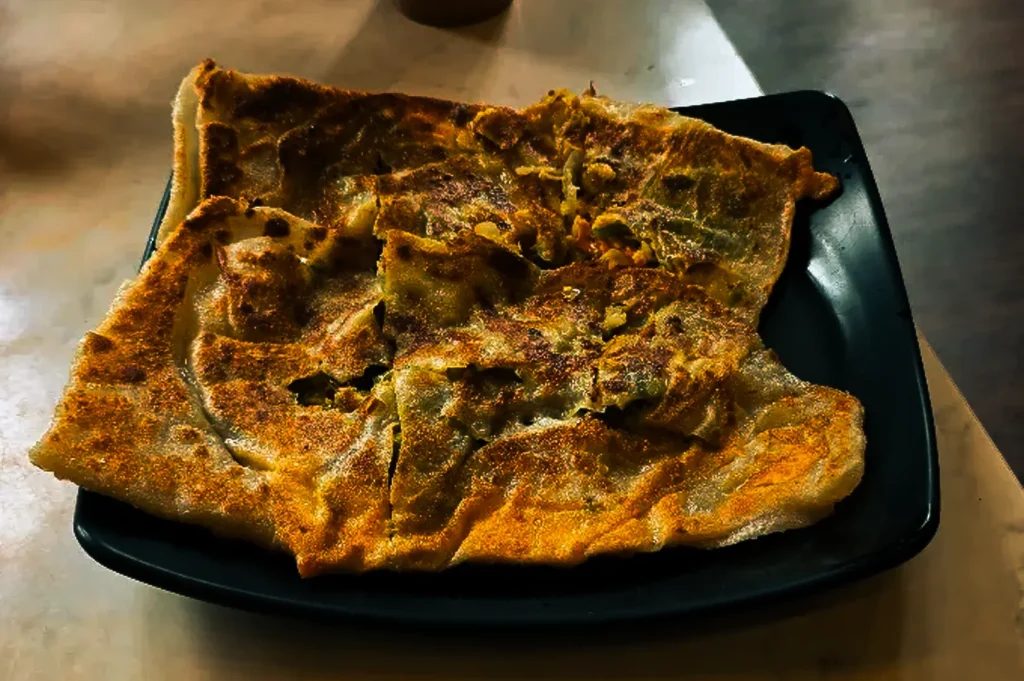
The frame I kept came on the third murtabak. The square sat in the lower half of the picture, its surface blistered gold and brown, the spatula’s edge just entering from the right. A little steam rose where the dough had split at one corner, showing a sliver of the spiced filling beneath. His hand stayed at the edge of the frame. I left his face out. The flour on his knuckles said enough.
A moment later, the murtabak was cut into pieces, slid onto a plate and carried away to a table near the door.
I had come to photograph a fold. What I found was the pause after it.
So much of what happens at a griddle like this is too quick to see. The skill lives in the motion, and the motion refuses to be held. The camera can only catch what the work allows it to catch: the resting crust, the oil settling, the hand lifting away. Perhaps that is honest. The fold belongs to the cook. The photograph only gets what comes after.
I stayed a while longer and stopped shooting. The tables turned over slowly. New dough went down on the iron. Another sheet was stretched thin under the white light, and I watched it fold without lifting the camera at all.
Outside, the mosque was still lit. The griddle was still hissing.

A Fold Too Quick for My Camera: Photographing Murtabak at Singapore Zam Zam
Sarah Teh | November 12, 2026
The dough was already folded by the time I found focus. I had been watching the griddle for less than a minute. A man at the front of the shop stretched a sheet of dough so thin the light passed through it, he laid it flat on the hot iron and spooned the filling into…
-
Best Late-Night Stalls at Lau Pa Sat: 7 Food Stops Worth Visiting After Dark
Sarah Teh | November 11, 2026
The cast-iron roof holds the last of the evening heat. Outside, Boon Tat Street closes to traffic, and the first charcoal grills begin to smoke, filling the air with a distinctive smoky aroma. If you are looking for food at Lau Pa Sat after dark, this list is a place to start. It gathers seven…
-
Walking Home With My Camera Full: A Night Photographing Geylang’s Food Streets
Sarah Teh | November 5, 2026
The gravy caught the light before the plate reached the table. I watched it travel from the kitchen in someone’s hand, a wide plate of beef kway teow still moving slightly from the walk, the surface shining under the fluorescent tubes. By the time it landed in front of me, the glare had settled into…
-
How to Capture Smoke on a Satay Stall at Night in Singapore
Sarah Teh | November 4, 2026
The charcoal glows before the smoke rises. I watch the skewers lying across the grill in tight rows. A hand turns them in one smooth motion, and fat drips onto the coals. Smoke lifts in a grey sheet, finds the warm bulb above the stall, and drifts toward the tables. Nearby, a plate waits with…
-
Smoke Across Boon Tat Street: Photographing Satay Stalls 7 and 8 at Lau Pa Sat
Sarah Teh | October 29, 2026
The smoke reached the light before I was able to capture the photo. The smoke rolled off the grill in a low, heavy sheet and drifted across Boon Tat Street, catching the bare bulbs strung above Satay Stalls 7 and 8. For a moment the whole stall turned soft and grey. Then a hand swept…
-
Chong Pang Huat: Chasing Smoky BBQ Chicken Wings and Satay After Dark
Sarah Teh | October 28, 2026
Smoke finds the light before anything else does. It lifts off the grill in loose grey threads, then it rises into the glow of the stall sign, and thins out somewhere above the tables. Below it, skewers are laid in rows and turned by hand. Chicken wings darken slowly at the edges. At a satay…
-
The Last Sweet Bowl: Photographing 75 Ah Balling Peanut Soup After Dinner
Sarah Teh | October 22, 2026
The steam went up before I was ready for it. I had my camera against my chest, waiting, and the vendor lifted the ladle without warning. Warm vapour curled off the surface of the peanut soup and caught the fluorescent tube overhead. I raised the lens and pressed the shutter, but the moment had already…
-
Best Chirashi Don Singapore: Fresh Sashimi Bowls from Daylight to City Lights
Sarah Teh | October 21, 2026
The city cools slowly after sunset. The neon signs warm up, and the crowds thin into something quieter. This is the hour when a bowl of fluffy Japanese rice topped with cold raw fish starts to make sense. Not the flash of a grill or the roar of a wok, but something still. Cubed sashimi…
-
The 3AM Bowl: Why Hock Heng Fish Soup Feels Different Before Sunrise
Sarah Teh | October 21, 2026
The steam rose before the light did. I stood with my camera lowered, watching a hand lift a ladle over the pot, waiting for the moment the vapour would catch the fluorescent tube overhead. It came in a slow curl, thin and pale, drifting up past the vendor’s wrist. Then the fish slices went in….
-
Prawns Beneath Fluorescent Light: A Late Shoot at ONE.85 Big Prawn Mee
Sarah Teh | October 15, 2026
The broth was the reddest thing in the stall, and the light was doing its best to kill it. It was past eleven at ONE.85 Big Prawn Mee, and I had been standing at the counter for a while, camera down, watching the uncle work the pot. He lowered a metal basket of noodles into…