The curry would not sit still.
It had arrived in a small metal bowl beside the plate, still moving from the walk between counter and table. A thin skin of oil turned slowly on its surface. Every time it shifted, the light above the table slid across it and broke into a white mark, bright enough to pull the eye away from everything else.
I waited for it to settle. It took longer than I expected.
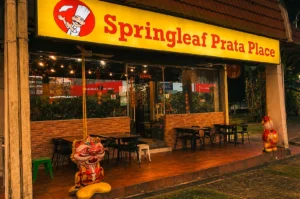
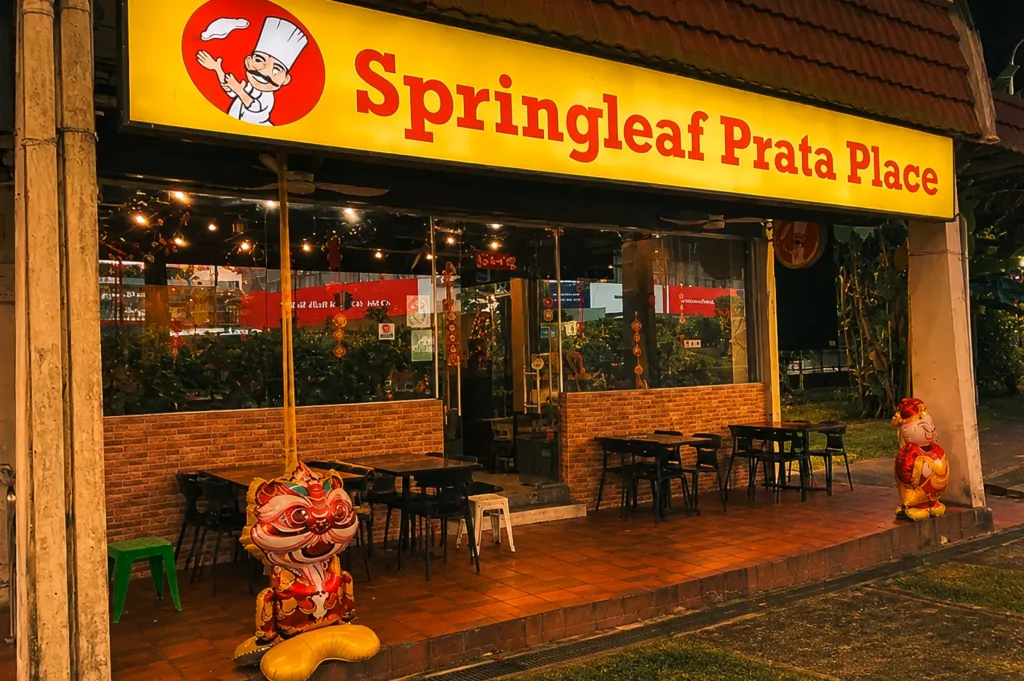
Springleaf Prata Place sits at 1 Thong Soon Avenue, in the north of the island, away from the city’s late crowds. I had come in the evening, after the sky had gone fully dark. The shop was lit from within, and that light spilled out over the tables in a flat. Cars pulled in and out of the road outside. A few families sat close together, plates between them, hands tearing bread without looking down.
Near the front, the prata was being made.
A man worked a ball of dough across a flat surface, pressing and stretching it until it thinned. Then he lifted it, swung it once through the air, and laid it on the hot griddle. It went down pale and came up spotted gold. He folded it in on itself with the edge of a spatula, pressed it flat, turned it. Another ball of dough was already waiting under his other hand.
There was no pause in it. One plate left, and the next began.
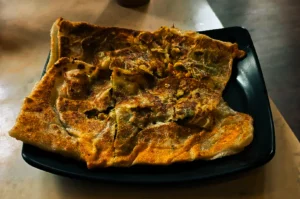
My prata sat on the table in front of me, torn into pieces, the outer layers crisp and curled at the edges. Inside, the bread was soft and pulled apart in folds. Beside it, the curry glowed a deep orange-brown, flecked with darker spice.
The problem was the bowl.
Curry is a liquid mirror. Under overhead light, its surface throws back the ceiling, the tubes, the shape of anyone leaning over it. In my first frames, the curry took over. It was the brightest thing in the picture, and the prata, which was the reason I had come, sat beside it looking dull and grey.
I tried shooting from above. The glare only grew. I tried tilting the bowl. The oil pooled to one side and caught the light even harder.
So I left the curry where it was and moved the frame instead.
I lowered the camera until it sat almost level with the table. From there, I looked across the prata rather than down at it. The light skimmed the crisp layers and caught every ridge and blistered edge. The folds showed their depth. Small flakes lay scattered across the plate, each holding a speck of warmth.
Then I slid the curry to the very edge of the frame.
Only part of the bowl stayed in. A curve of metal. A slice of orange surface, the glare now reduced to a thin line along the rim. It no longer competed. It waited at the border, the way it waits on the table, ready for the bread to come to it.
The frame I kept came when someone at the next table reached across with a torn piece of prata and dragged it through their own curry. I was not photographing them. But their movement made me look again at my own plate, and I tore a piece and dipped it, and held it above the bowl for a moment while the curry ran back down. I took one frame with my other hand. The bread was soft at the tip, crisp at the fold, and a single drop of curry hung from its edge, caught in the light.
I set the camera down and ate.
I had spent the first part of the evening trying to keep the curry quiet. But prata alone is unfinished. It is made to be dipped, torn, shared. The curry belongs at the edge because that is where it lives in the meal: close, essential, never quite the centre.
Maybe that was the photograph all along. Not the bread or the bowl, but the small distance between them, and the hand that crosses it. if you like Japanese curry more, click here to see more late-night spots around Singapore.
Behind me, the griddle hissed again. Another sheet of dough rose into the air, turned once, and came down on the heat.

Curry at the Edge of the Frame: An Evening Photographing Prata at Springleaf
Sarah Teh | November 19, 2026
The curry would not sit still. It had arrived in a small metal bowl beside the plate, still moving from the walk between counter and table. A thin skin of oil turned slowly on its surface. Every time it shifted, the light above the table slid across it and broke into a white mark, bright…
-
Alliance Seafood Review: Singapore Seafood at Newton Food Centre
Sarah Teh | November 18, 2026
Crab at a hawker centre is never a quiet meal. Shells crack. Sauce reaches the wrist. Someone tears a mantou in half and drags it across the plate. Then there is Alliance Seafood, spilling the lively chaos of shared tables and sizzling woks at stall #01-27, Newton Food Centre, 500 Clemenceau Avenue North, Singapore 229495….
-
Singapore Food Photography: How to Capture Seafood Dishes
Sarah Teh | November 16, 2026
The plate lands with a soft knock on the table. Chilli crab, still carrying the heat of the wok. Sauce slides from a claw and gathers around the shell. A bulb overhead leaves a small white mark on the gloss. Steam rises for a few seconds, then the fan takes it. Across the table, someone…
-
A Fold Too Quick for My Camera: Photographing Murtabak at Singapore Zam Zam
Sarah Teh | November 12, 2026
The dough was already folded by the time I found focus. I had been watching the griddle for less than a minute. A man at the front of the shop stretched a sheet of dough so thin the light passed through it, he laid it flat on the hot iron and spooned the filling into…
-
Best Late-Night Stalls at Lau Pa Sat: 7 Food Stops Worth Visiting After Dark
Sarah Teh | November 11, 2026
The cast-iron roof holds the last of the evening heat. Outside, Boon Tat Street closes to traffic, and the first charcoal grills begin to smoke, filling the air with a distinctive smoky aroma. If you are looking for food at Lau Pa Sat after dark, this list is a place to start. It gathers seven…
-
Walking Home With My Camera Full: A Night Photographing Geylang’s Food Streets
Sarah Teh | November 5, 2026
The gravy caught the light before the plate reached the table. I watched it travel from the kitchen in someone’s hand, a wide plate of beef kway teow still moving slightly from the walk, the surface shining under the fluorescent tubes. By the time it landed in front of me, the glare had settled into…
-
How to Capture Smoke on a Satay Stall at Night in Singapore
Sarah Teh | November 4, 2026
The charcoal glows before the smoke rises. I watch the skewers lying across the grill in tight rows. A hand turns them in one smooth motion, and fat drips onto the coals. Smoke lifts in a grey sheet, finds the warm bulb above the stall, and drifts toward the tables. Nearby, a plate waits with…
-
Smoke Across Boon Tat Street: Photographing Satay Stalls 7 and 8 at Lau Pa Sat
Sarah Teh | October 29, 2026
The smoke reached the light before I was able to capture the photo. The smoke rolled off the grill in a low, heavy sheet and drifted across Boon Tat Street, catching the bare bulbs strung above Satay Stalls 7 and 8. For a moment the whole stall turned soft and grey. Then a hand swept…
-
Chong Pang Huat: Chasing Smoky BBQ Chicken Wings and Satay After Dark
Sarah Teh | October 28, 2026
Smoke finds the light before anything else does. It lifts off the grill in loose grey threads, then it rises into the glow of the stall sign, and thins out somewhere above the tables. Below it, skewers are laid in rows and turned by hand. Chicken wings darken slowly at the edges. At a satay…
-
The Last Sweet Bowl: Photographing 75 Ah Balling Peanut Soup After Dinner
Sarah Teh | October 22, 2026
The steam went up before I was ready for it. I had my camera against my chest, waiting, and the vendor lifted the ladle without warning. Warm vapour curled off the surface of the peanut soup and caught the fluorescent tube overhead. I raised the lens and pressed the shutter, but the moment had already…