The charcoal glows before the smoke rises.
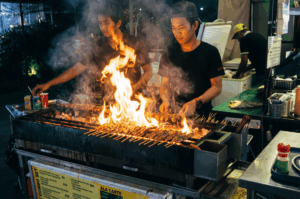
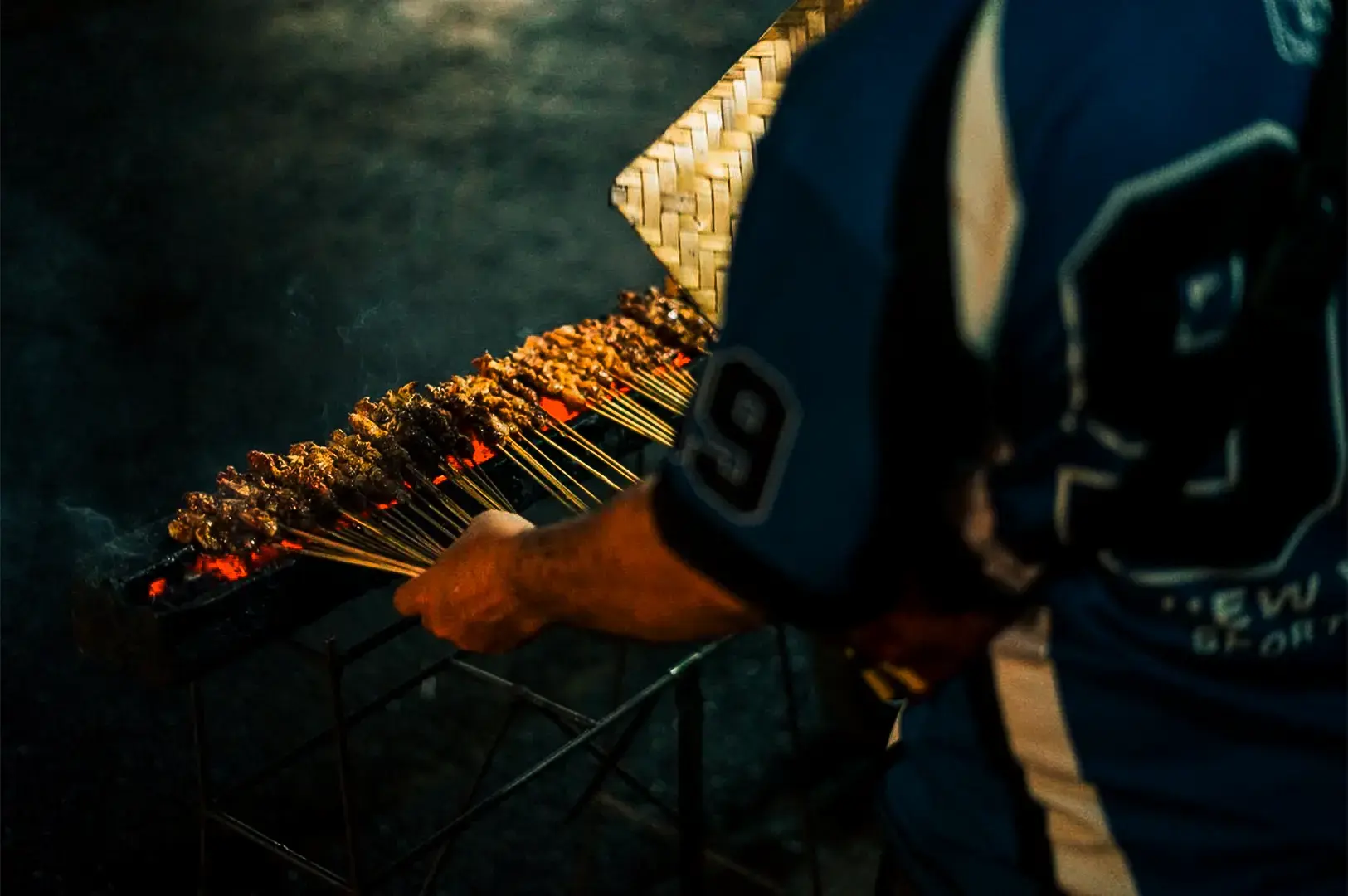
I watch the skewers lying across the grill in tight rows. A hand turns them in one smooth motion, and fat drips onto the coals. Smoke lifts in a grey sheet, finds the warm bulb above the stall, and drifts toward the tables. Nearby, a plate waits with peanut sauce, cucumber, and raw onions.
I raise my camera. By the time I press the shutter, the smoke has moved.
This guide is about that gap. I’ll show you how I photograph smoke at a satay stall at night without losing the food in haze, and without getting in the way of the people doing the cooking.
Why Singapore Satay Smoke Is Hard to Photograph at Night
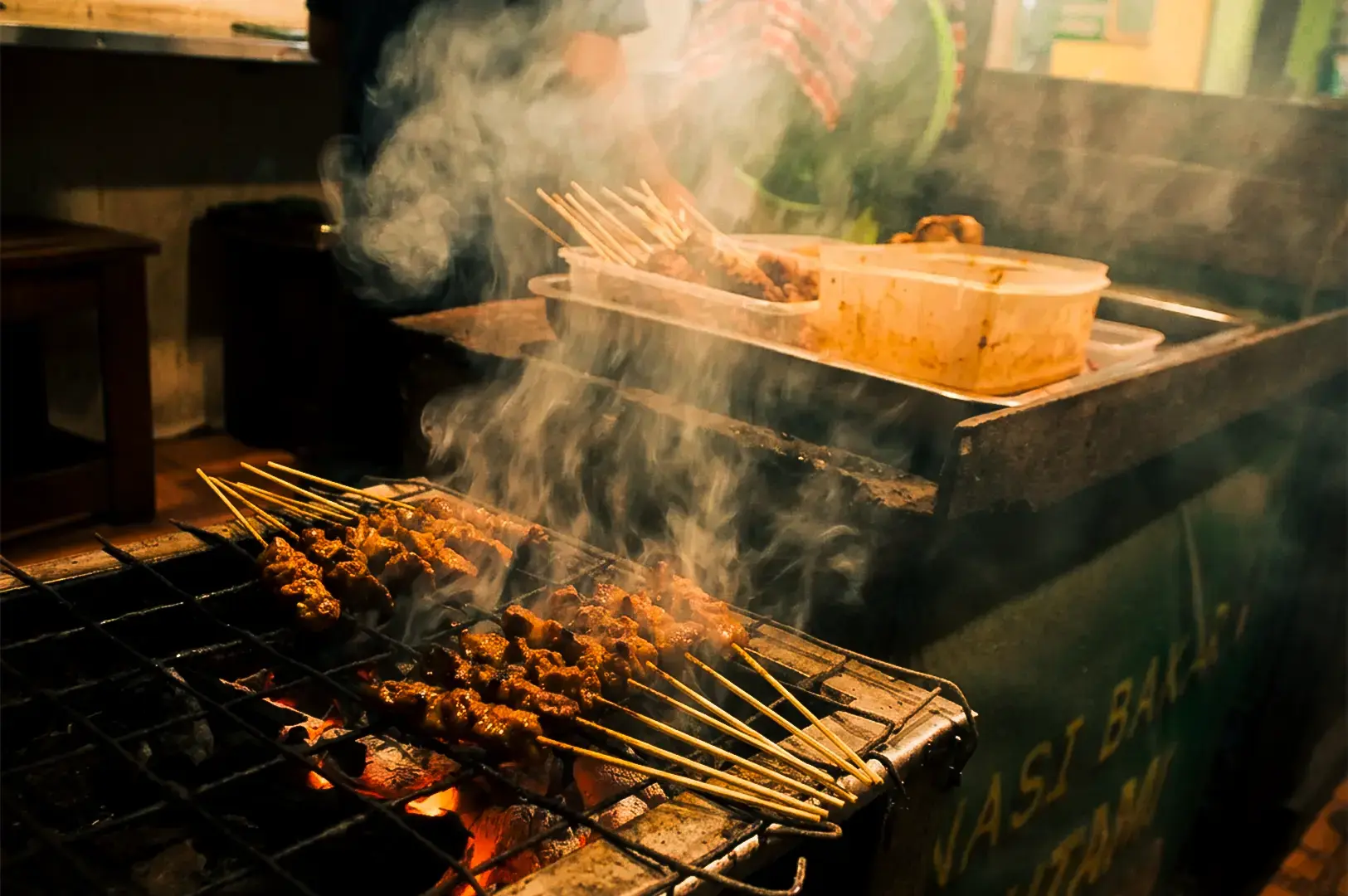
Smoke has no edges. My camera needs edges.
At night, autofocus searches for contrast. Smoke offers almost none, so the lens hunts back and forth while the moment passes.
Light direction matters too. Smoke only shows up when light passes through it from the side or from behind. Lit from the front, it turns into a flat giving the photo a milky veil.
Then there is motion. Smoke shifts with every breath of wind. Hands move fast. Skewers turn in batches.
Most Singapore satay stalls also mix their light. Warm bulbs, cool fluorescent tubes, neon signs and orange coals all sit in one frame. My camera tries to balance them and often gets none of them right.
And the brightest things in the scene, the flames, the bulbs, the oiled metal, can burn out to pure white while the meat stays dark.
Camera Settings for Chicken Satay, Mutton Satay, and Pork Satay Smoke Shots
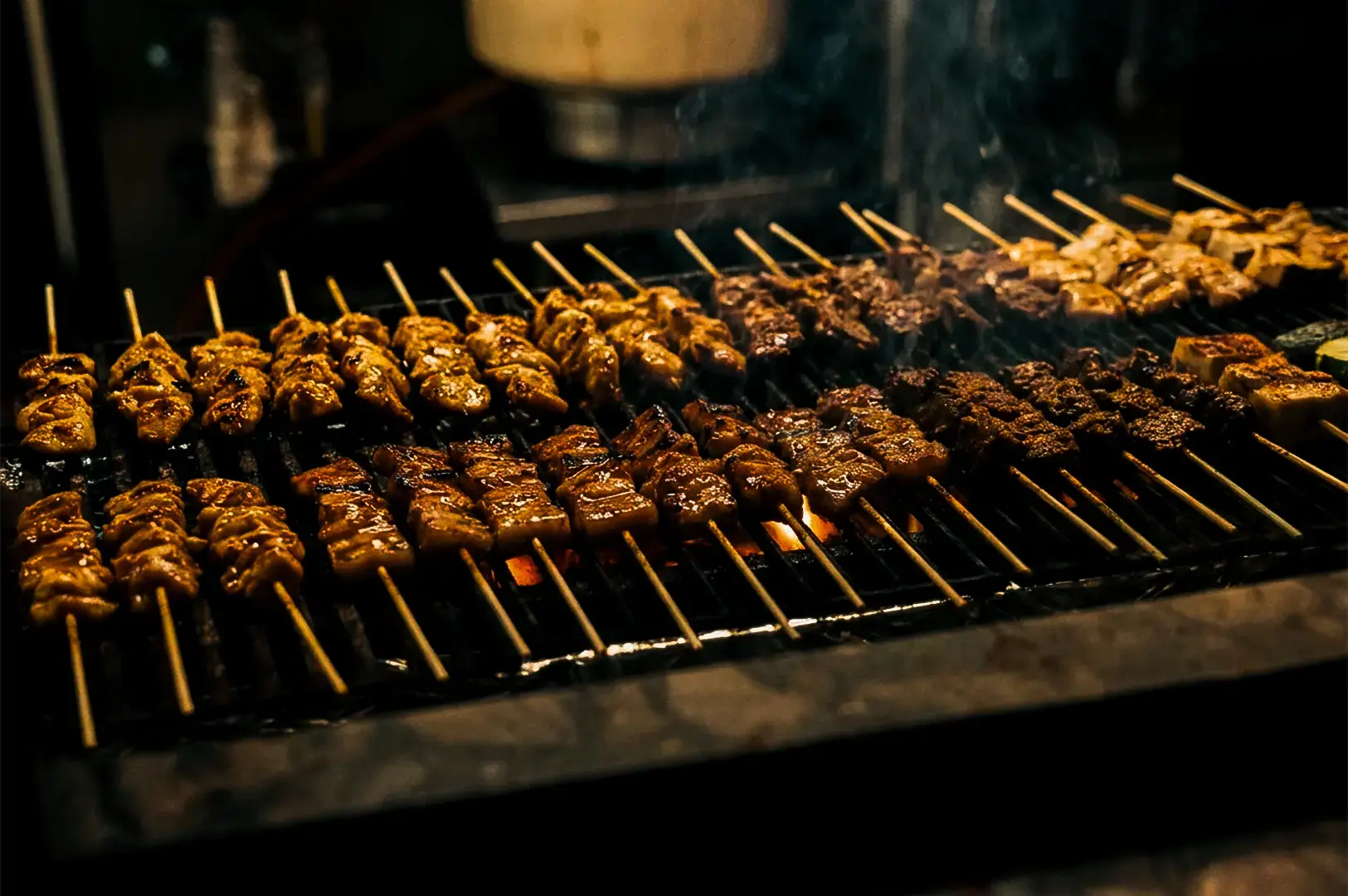
I treat these as starting points. Every stall has its own light, and every evening has its own wind. Here are the camera settings that works well with me.
Photography Subject | Aperture | Shutter Speed | ISO Range |
|---|---|---|---|
Close-up smoke and satay | f/1.8 to f/2.8 | 1/125 to 1/250 | 1600 to 6400 |
Vendor hand movement | f/2 to f/3.5 | 1/250 or faster | 3200 to 6400 |
Wider street food scenes | f/4 to f/5.6 | 1/60 to 1/125 | 1600 to 6400 |
A beginner starting point | f/2.8 | 1/200 | 3200 |
Additional beginner settings:
- Manual mode or aperture priority
- Auto white balance, or Kelvin around 3200K to 4200K
- Burst mode on
- Slight underexposure if the flames or stall lights are too bright
I use continuous autofocus with a single small focus point. I focus it on the meat, not the smoke.
I keep my shutter fast. A fast shutter at high ISO will add grain. I accept it. Slight grain is better than a clean but blurry image. Grain can look like texture. Blur only looks like a mistake.
On a phone
- I use the main lens. It handles low light best.
- I tap and hold to lock focus on the satay or the grill edge.
- I slide exposure down a little if flame or bulbs are blowing out.
- I avoid extreme digital zoom. I step closer instead, if there is room.
- I turn off heavy night mode if it smears moving smoke or hands.
- I take many frames. The smoke will never look the same twice.
How to Use Light Around Satay Stalls Without Flash
The stall already has the light I need. My job is to find where it falls.
Side light is my strongest tool. When a bulb sits to one side of the grill, smoke passing through it turns bright and shows its shape. Char marks on the meat gain depth.
Backlight works even better for smoke. I move so the stall lamp sits behind the rising haze, just outside the frame. The smoke glows from within.
Dark backgrounds do the rest. Smoke is easier to see against shadow: a dark awning, an unlit wall, the night sky above the street.
Front light, including direct flash, does the opposite. It hits the smoke head-on and flattens it into grey fog. Flash also bounces off oil and metal, and it startles people working at the grill. I leave it off.
How to Make Smoke Visible Above the Grill
I watch before I shoot.
Smoke has a rhythm. It builds while the skewers sit still. It thins when the vendor fans the coals or turns a row. I learn that pattern over a few minutes, and I know when to raise the camera.
I read the wind. I notice which way the smoke drifts, then stand to one side of it, not in its path. Smoke blowing into my lens softens everything.
I look for a dark area behind the grill and line it up with the rising smoke.
I expose for the highlights. If the bulbs and coals still hold some detail, the shadows can usually be lifted later. Burnt highlights cannot be brought back.
Then I shoot in short bursts. When the fan sweeps or a hand flips the skewers, I hold the shutter for two or three seconds. One frame in that run will usually catch the smoke at its clearest.
For more guides on how to capture in a low light setting you can check out our other article about capturing sushi photographs.
How to Compose Satay, Peanut Sauce, Onions, and Skewers
I focus with the food. The smoke is context, not the subject.
I place skewers in the foreground on a slight diagonal. The lines lead the eye through the frame, and the diagonal gives the image movement. I let the smoke rise along a second diagonal behind them.
I focus on something solid: the grill edge, a row of skewer tips, the char on a piece of chicken satay. The textures of grilled meat, fat and spices carry the story of the fire.
Hands bring the frame to life. A wrist turning a row of sticks. A palm-leaf or bamboo fan mid-sweep. I can keep the face out of frame and still show the work.
On the plate, I keep things simple. A small bowl of peanut sauce, cut cucumber, raw onions, and ketupat where the stall serves it. I shoot low, near table level, so the sauce catches some light.
I leave a little background in. Blurred diners, a neighbouring stall sign, a row of tables. That is how the image says where it was made.
Where to Practice: Lau Pa Sat and Other Singapore Satay Settings
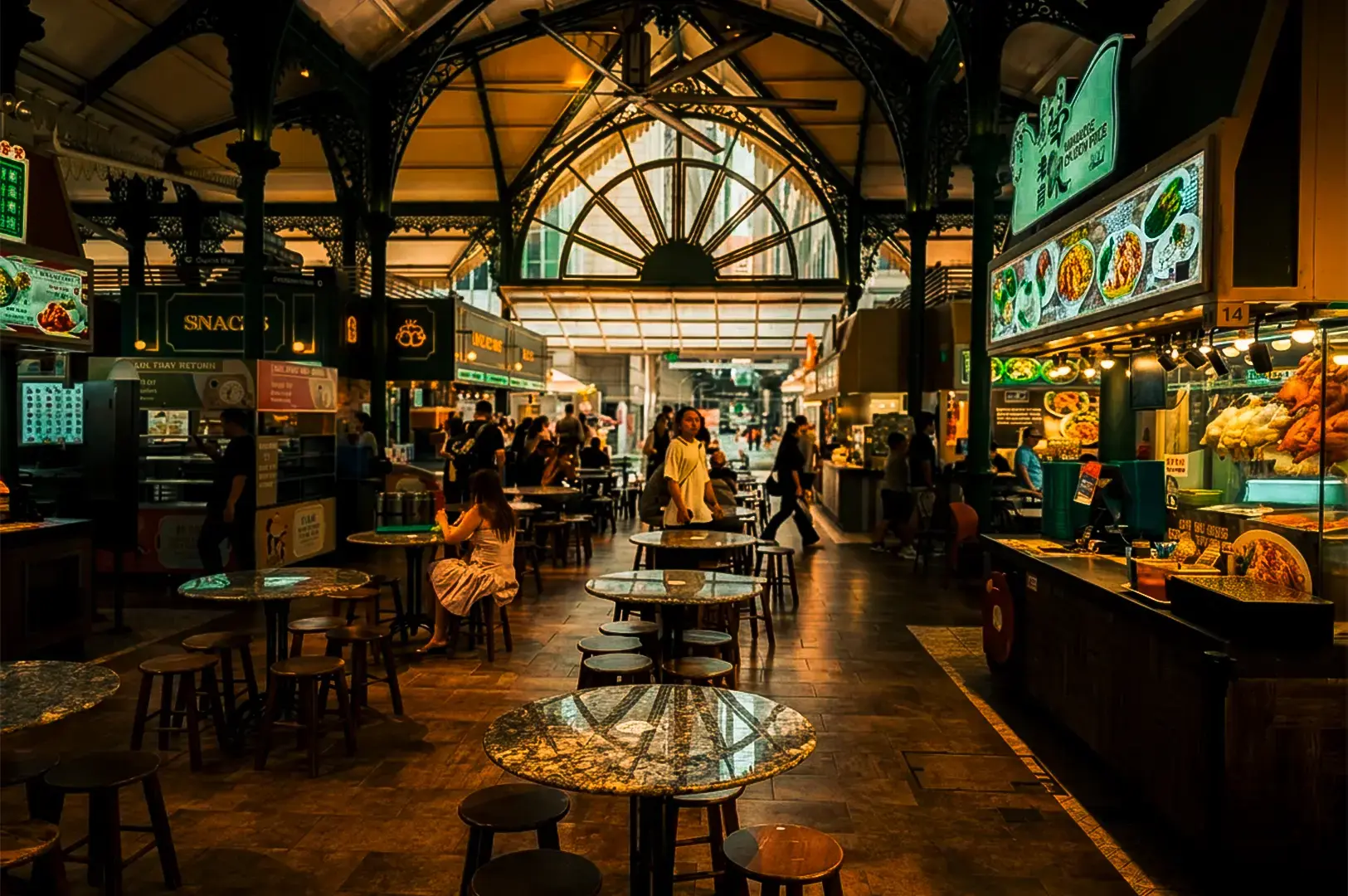
Lau Pa Sat, at 18 Raffles Quay, Singapore 048582, is a common place I start. Lau Pa Sat describes its Satay Street as Singapore’s largest open-air Satay Street, set up on Boon Tat Street from 7pm onwards.
Its listed Satay Street hours are 7pm to 3am on weekdays and 3pm to 3am on weekends. Nearby MRT stations include Downtown, Raffles Place, Shenton Way and Telok Ayer.
Many neighbourhood food centres also have satay stalls, and they often offer quieter conditions with fewer crowds. When searching satay sg or satay singapore, I come across names like Kwong Satay, Haron Satay and Yong Seng. Each setting has a different layout, light and pace, so I check opening hours before I go. Newton Food Centre also has some late night satay stalls if your looking for more options.
Menus vary. Some stalls serve pork satay or pork belly satay. Others focus on chicken, mutton or beef. I do not assume any stall serves a particular meat or carries halal certification. I check the stall itself.
Should You Eat Satay Before or After Shooting?
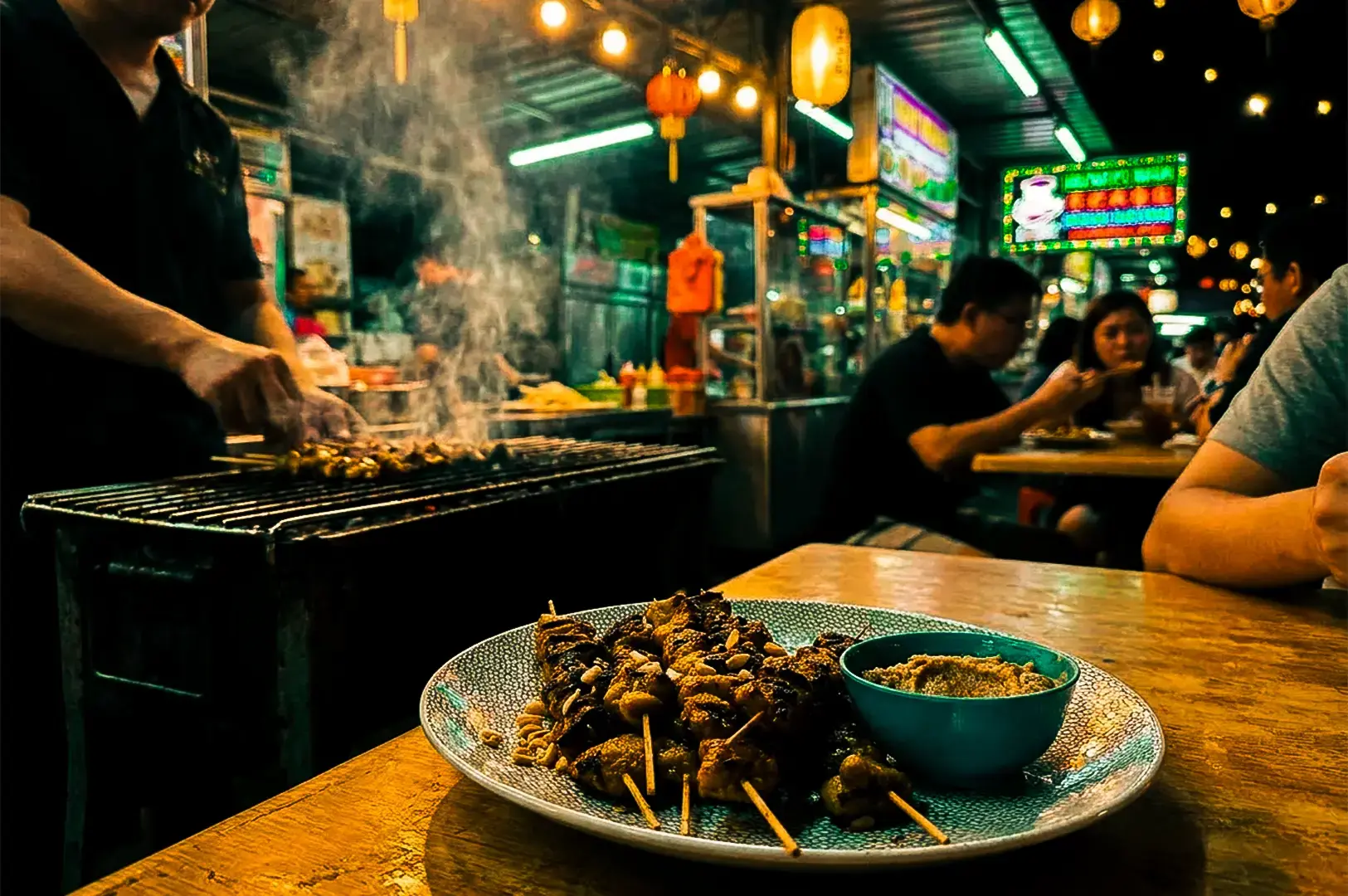
I order first.
If I plan to spend time near a stall, I buy food. It is a simple way to show respect for the people whose space I am using. The satay stalls that I usually order has a generous serving and an amazing flavour bursting in my mouth.
I photograph my plate while it is still hot. Steam and gloss fade within minutes.
I keep my distance from the grill. I stay out of walkways and away from the vendor’s working space. I ask before photographing identifiable people or stallholders up close.
Then I put the camera down and eat. Satay in Singapore is meant to be eaten warm. I do not let a photo cost me the meal.
I usually have a friend with me so that we can explore more late-night food finds together and so that we can share and enjoy the food together.
Common Mistakes When Photographing Satay in Singapore
- Shooting smoke against a bright background. It disappears into the light.
- Using a shutter speed that is too slow. Hands and skewers blur.
- Focusing on the smoke instead of the food. Autofocus hunts, and the meat goes soft.
- Standing too close to the grill. I block the work, and the heat and smoke reach my lens.
- Relying on direct flash. It flattens smoke and distracts vendors.
- Over-editing smoke. Heavy haze or clarity sliders make it look fake.
- Making the whole image too orange. I pull warmth back so the meat keeps its colour.
- Cropping out all local context. Without the street, it could be anywhere.
What “Best Satay” Photos Usually Have in Common
This is not about which stall is best. It is about what tends to work in the frame.
Strong satay photographs usually show:
- Smoke that has shape, lit from the side or behind
- Visible char on the meat
- Textures you can almost feel: fat, glaze, grain
- Peanut sauce that looks rich, not muddy
- A human gesture, even a partial one
- A dark background that lets the light do its work
- A sense of place, however small
Final Thoughts
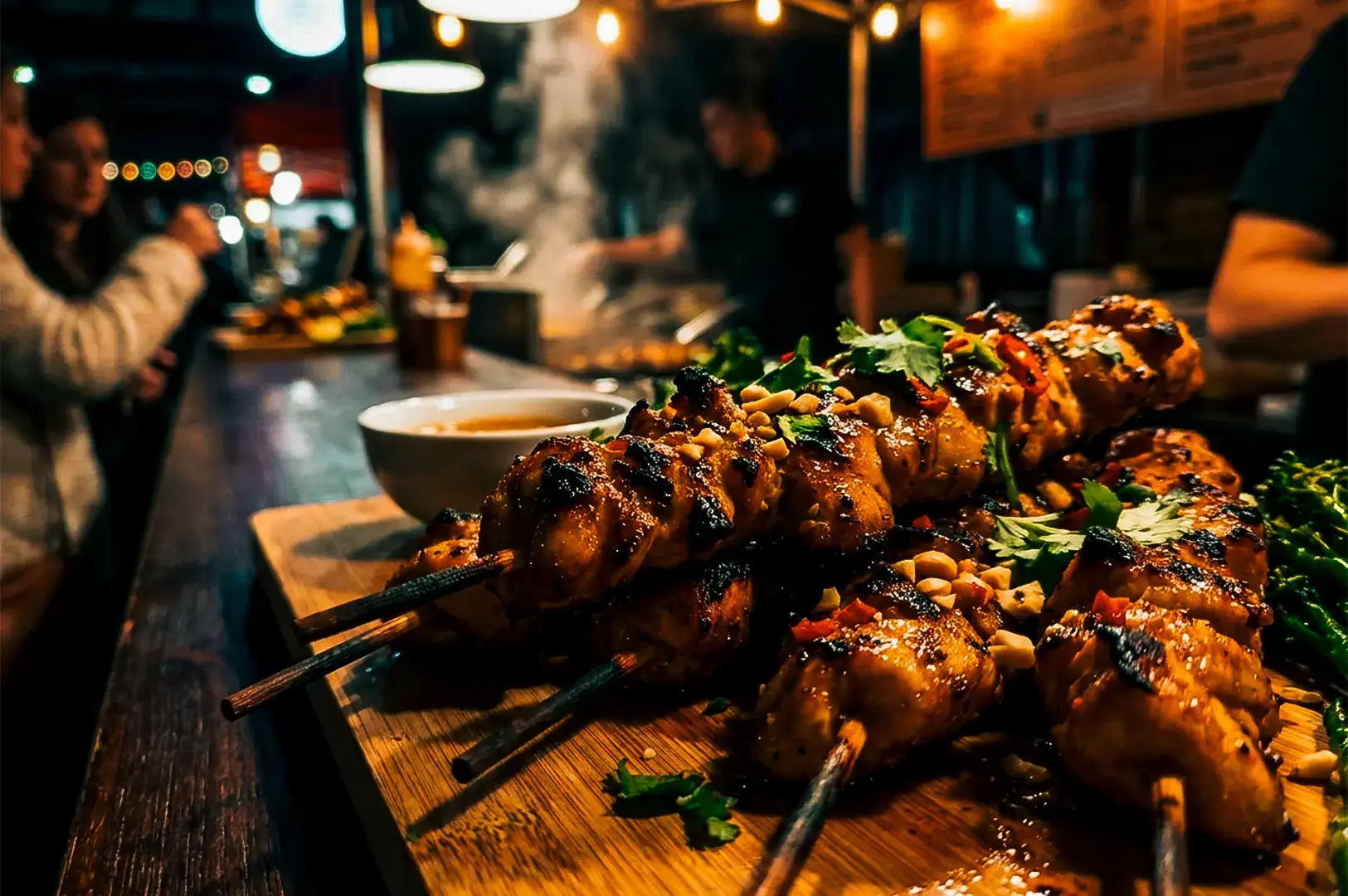
A good satay smoke photograph is rarely only about smoke.
It is about heat rising from charcoal. A wrist turning a row of sticks. Light that lands for a second and then moves on. Food made in front of me, eaten a few steps away. The goal is to help the audience see what I see while eating at that stall. The smoke in the photograph can symbolize the fragrant aroma of the satay.
The smoke is just how I know it was there.

6ix 6ix: Framing a 24-Hour Sichuan Kitchen Hidden Along Cuppage Road
Sarah Teh | August 19, 2026
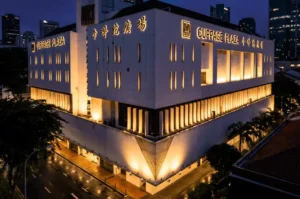
6ix 6ix After Midnight Cuppage Road goes quiet after the dinner crowds thin out. The shophouses along Cuppage Terrace dim, Cuppage Plaza rescinds into darkness, and the street holds only the low hum of a few late cars and the occasional figure walking home. Then there is 6ix 6ix, spilling warm light onto the pavement…
-
Stillness Amidst the Chaos: Finding the Quiet Moments in the Noise of Nightly Eats
Sarah Teh | August 13, 2026
The wok never stopped roaring. It was almost midnight at a zi char stall in Geylang, and the flames kept leaping up in short, angry bursts. Trays clattered. Someone shouted an order across the aisle. A cleaner dragged a bin past my chair. I sat there with my camera in my lap, waiting for a…
-
Low-Light Sushi Photos: How to Frame Nigiri, Sashimi, and Maki During Dinner
Sarah Teh | August 12, 2026
The first time I tried to photograph nigiri at a proper counter, I ruined the piece. I fussed. I tilted the plate. I leaned back for a better angle, checked the screen, tried again. By the time I actually ate it, the rice had cooled and the fish had warmed, and that careful balance the…
-
From Smoke to Plate: The Delicate Dance of Food Photography at Midnight
Sarah Teh | August 6, 2026
The smoke reached me before the food did. It was close to one in the morning, and I was standing at a satay stall near Lau Pa Sat, watching a man fan his coals in slow, practiced strokes. Each pass sent up a curl of grey that caught the streetlight and vanished. I had my…
-
Inside Al Capone’s: A Late-Night Italian Photo Story at Cuppage Terrace
Sarah Teh | August 5, 2026
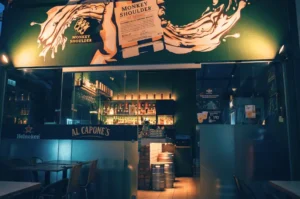
I nearly walked into Cuppage Plaza by mistake. That’s the thing people get wrong about Al Capone’s. It’s not inside the plaza at all. It sits a short walk away at 37 Cuppage Terrace, along that covered open-air stretch where the tables spill almost onto the walkway. I found it by following the sound first….
-
Beyond the Lens: How Food Photography Connects Us to the Heart of the Night
Sarah Teh | July 30, 2026
The first time I lowered my camera mid-shot, I knew something had changed in me. It was past midnight at Geylang Lor 9 Fresh Frog Porridge, a kway chap stall nearby still going strong. The uncle had just ladled broth over the rice, the steam curling up into the dim light, and instead of framing…
-
Cuppage Plaza Food After Dark: A Late-Night Dining List on Cuppage Road
Sarah Teh | July 29, 2026
Most people know Cuppage Plaza food during daylight hours especially during lunch hours. But I know it better after dark. For the past two years, I’ve made a quiet habit of ending my nights here, camera slung over one shoulder, appetite following close behind. I’ve watched the building change character after 11pm, when the lifts…
-
Late-Night Lighting: How to Embrace Darkness
Sarah Teh | July 23, 2026
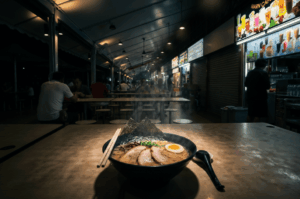
The first time I tried to photograph a bowl of noodles in the dark, I lost. I was at a supper stall past midnight, fiddling with settings, raising the brightness, fighting the shadows like they were the enemy. By the time I got a clean shot, the broth had gone tepid and the moment had…
-
Miss Saigon: A 2AM Bánh Mì in the Quiet of Orchard Plaza
Sarah Teh | July 21, 2026
I went looking for air, not dinner. It was late, the kind of late where Orchard Road empties out and the malls go soft and grey. I wandered up to the second floor of Orchard Plaza, located at 150 Orchard Road #02-56, and there it was, lit and open, a little Vietnamese store that doesn’t…
-
The Tension of the Moment
Sarah Teh | July 16, 2026
There is a half second at a wok stall that I have learned to live for. The flame leaps, the hand tilts, and the whole dish hangs in the air before it falls back into the pan. Miss it, and you get a flat plate of noodles. Catch it, and you get the night itself,…