The first time I tried to photograph nigiri at a proper counter, I ruined the piece.
I fussed. I tilted the plate. I leaned back for a better angle, checked the screen, tried again. By the time I actually ate it, the rice had cooled and the fish had warmed, and that careful balance the chef had built for me was gone. He didn’t say anything. He didn’t have to. I knew.
That was the lesson that changed how I shoot sushi photos at dinner. The photo is never worth the meal. And strangely, once I accepted that, my sushi photos got better.
Here’s what I’ve learned since, as I continue my journey through capturing food such as those from good Japanese curry Singapore offers, and now to sushi, mostly at dim counters, camera muted, moving fast.
Why Sushi Is So Hard to Photograph at Dinner
Three things work against you at once.
The light is low. Sushi rooms are quiet and warm, lit by a single spot over the counter and not much else. Your camera struggles the moment the sun goes down.
The food is fragile. Sushi is temperature-sensitive. Rice cools, fish warms, glaze sets. Every second you spend fiddling is a second the piece drifts away from how it was meant to taste.
The pacing isn’t yours. At a counter, the chef sets the rhythm. You eat when it’s placed, not when you’re ready. There’s no time to build a little studio.
So the goal isn’t a perfect shot. It’s a good enough shot, made fast enough that the meal survives.
Ask Before You Shoot
Before anything else, ask. Once. Quietly.
Photography rules vary wildly. Etiquette guidance from sources like TABLEALL points out that some restaurants allow food photos but not chef portraits, some permit only the nigiri portion, and some don’t allow any photography at all. You won’t know until you check.
A simple line works: “Is it okay if I take a few quiet sushi photos of the food?” Then respect whatever answer you get. Turn off your flash. Mute the shutter. Keep other diners out of your frame. And eat each piece promptly after it’s served, the way it’s meant to be eaten.
I’ve never once had a chef refuse a polite ask. What they mind isn’t the camera. It’s the disruption.
Pro tip: Keep your phone and keys off the wooden counter entirely. Those counters are expensive, and hard objects scratch. Set your camera in your lap between shots, not on the surface in front of you.
The Camera Settings I Start With
You want fast glass and forgiving settings. Here’s my starting point for a dim room:
- Aperture: f/1.8 to f/4
- Shutter speed: 1/100 to 1/200 second
- ISO: 800 to 3200, sometimes higher in very dark rooms
- File type: RAW
- White balance: Auto, then fix it later
A slightly grainy but sharp sushi photo beats a clean but blurry one every time. Don’t cling to ISO 100 because you’ve heard it’s “best quality.” In a dark restaurant, ISO 100 forces a shutter speed so slow your hands will blur the shot. Raise the ISO. Keep 1/125 as your handheld safety line.
Shoot RAW if you can. Mixed restaurant lighting will throw strange casts on your fish, and RAW lets you correct white balance later without wrecking the file.
How to Frame Nigiri
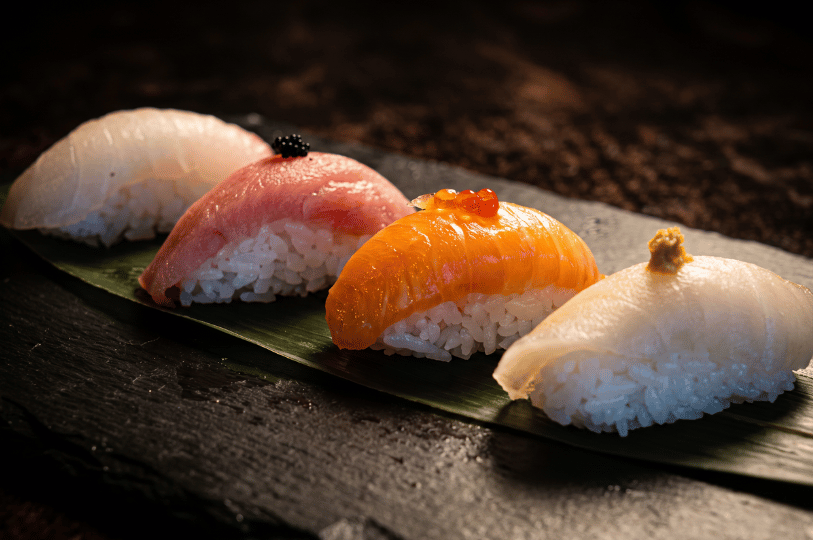
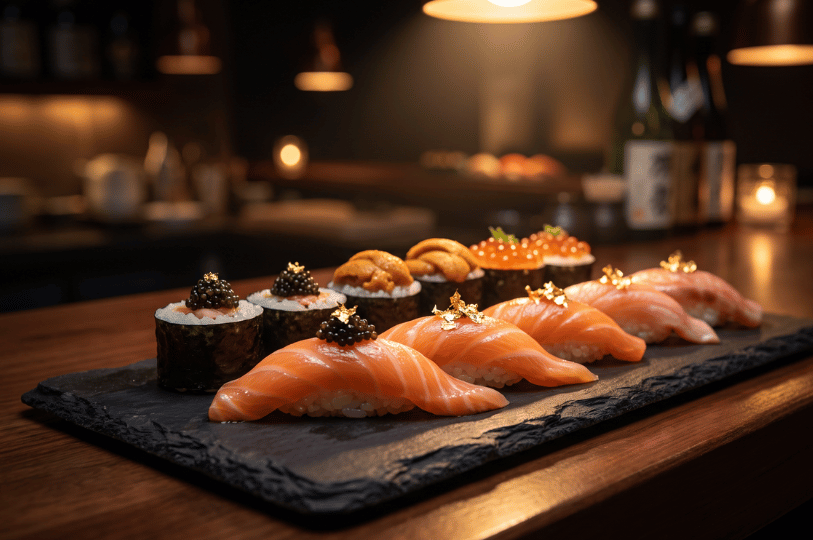
Nigiri is about the relationship between the fish and the rice. Shoot it too flat and you lose that entirely.
Get low. A 30 to 45-degree angle shows the height of the piece, the curve of the topping, any brush of sauce, and the structure of the rice underneath. Overhead flattens all of it into a shape.
Focus on the front edge of the fish, leave a little counter around the piece, and let the chef’s workspace fall soft in the background. And here’s the important part: rotate yourself, not the sushi. Never move a piece the chef has placed unless you’re invited to.
Two frames is enough. One at 45 degrees, one tighter detail. Then chopsticks.
How to Frame Sashimi
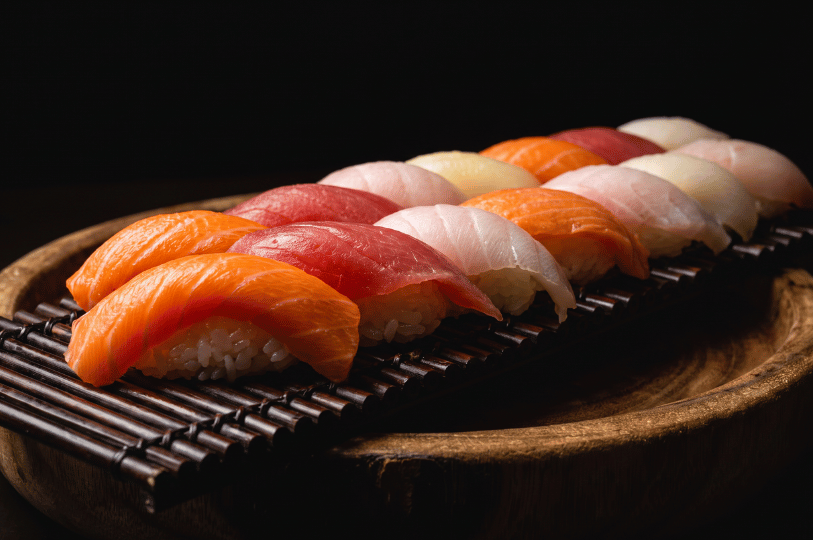
Sashimi gives you more room to work because it usually arrives arranged, with leaves, ice, daikon, or ceramic shaping the plate.
Look for the lines. Clean knife cuts, a diagonal progression across the plate, alternating colours, the negative space that separates each variety. Those are your composition, already done for you.
Shoot overhead when the arrangement is graphic and flat. Switch to 45 degrees when there’s height, garnishes standing up, or a glossy cut surface catching light. Let the empty space breathe. You don’t need to fill the frame.
How to Frame Maki and Hand Rolls
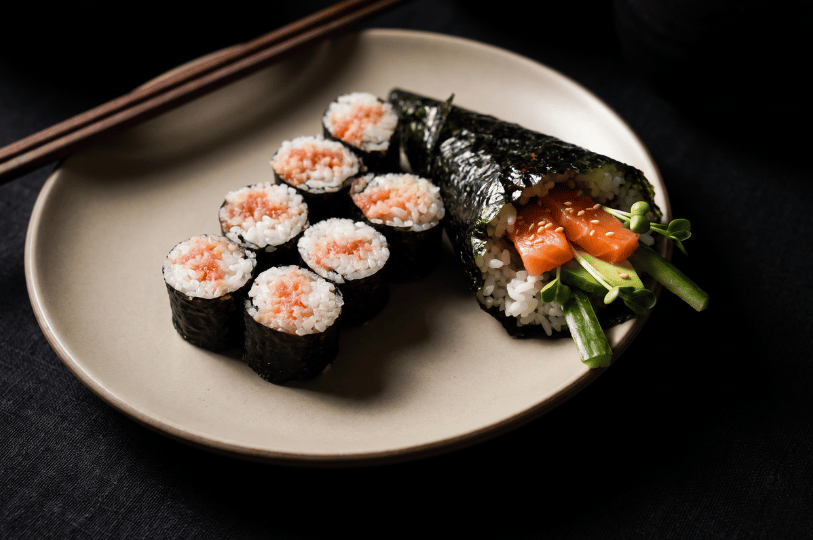
With maki, decide what the picture is about first.
If it’s about pattern, shoot overhead. A row of cut maki becomes circles and repetition, and aligning them on a diagonal makes it sing.
If it’s about the filling, get low toward the cut end. That’s where you see the rice thickness, the layers, the ingredients. For a hand roll, shoot slightly below or level with the open end so the filling shows. Don’t accidentally land your focus on the nearest bit of nori when the filling is the real story.
Insider knowledge: For a temaki, you’ve got maybe thirty seconds before the nori softens and goes limp. Have your angle chosen before it arrives. Crisp nori photographs beautifully. Soft nori just looks tired.
Taste more of Singapore’s wonders of sushi counters from omakases to izakayas, especially within Cuppage Plaza, from me on Midnight Photographer.
Controlling Warm and Mixed Light
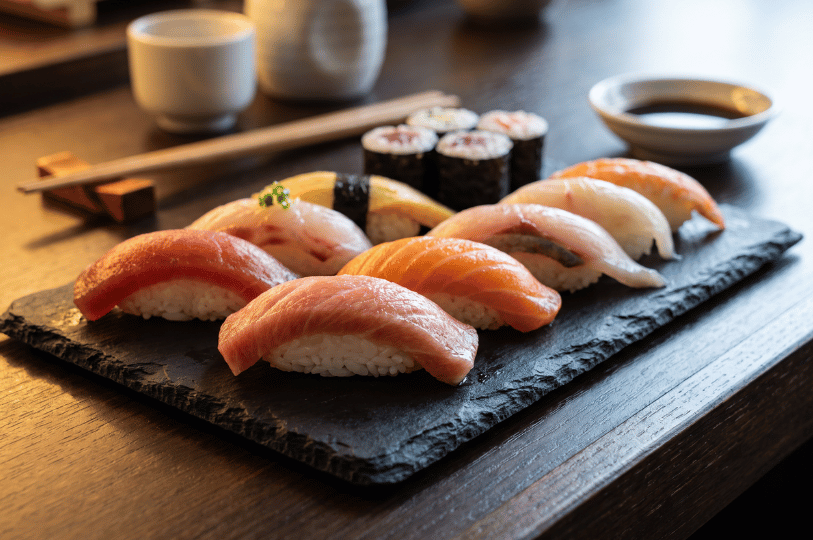
Restaurant light is your biggest enemy and, handled right, your best friend.
Skip the flash. It flattens the fish, throws harsh reflections off glaze, and kills the quiet mood of the room. Nobody wants to be the person firing a flash at a sushi counter.
Instead, work with what’s there. Look at the shadow cast by your teacup or chopstick rest to find where the light’s coming from. Side and back light reveal texture far better than flat frontal light. Turn your plate, or turn yourself, so the strongest light rakes across the food from the side.
For colour, don’t try to neutralize everything. A little warmth keeps the atmosphere. When you edit your RAW file, use the rice or a white ceramic edge as your reference, then pull the yellow back just enough that the rice looks warm rather than grey. Watch salmon, tuna, and wasabi separately. They each shift differently.
A 5-Second Omakase Workflow
At omakase, the chef serves a piece every few minutes, and the pressure to capture everything is real. Resist it.
Here’s my whole routine:
- Ask about photography before service starts.
- Lock in one exposure that works for the counter.
- Photograph only the pieces that matter, not all of them.
- Alternate between food, the chef’s hands, and the room.
- Don’t review after every shot.
- Eat each piece straight away.
You’ll leave with a coherent set of ten to fifteen frames instead of eighty near-identical close-ups. Photograph the progression, not the inventory.
Common Mistakes to Avoid
I’ve made all of these.
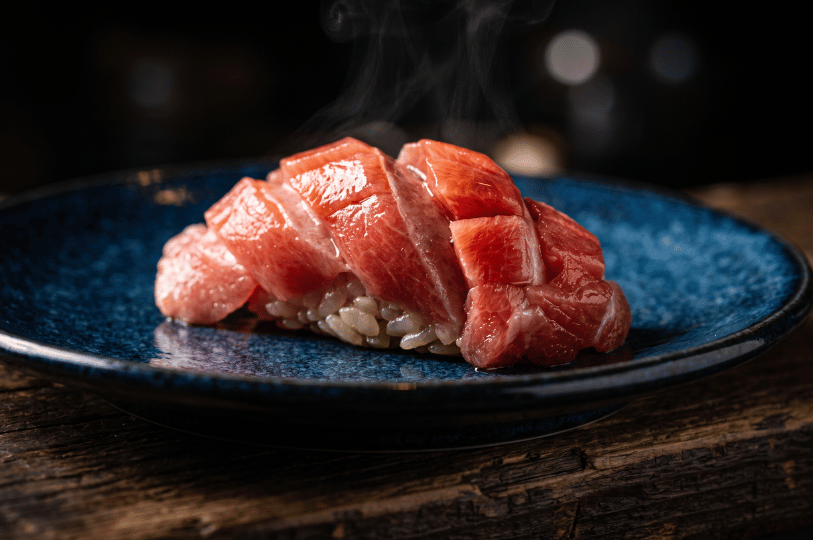
- Blown highlights on oily fish. That white patch on the tuna is gone for good. Dial in about –0.3 to –0.7 exposure compensation to protect it.
- Shutter too slow to handhold. If you can’t hold it steady, raise ISO. Don’t accept blur.
- Night mode blurring the chef’s hands. Phone night mode stacks multiple frames, so anything moving comes out doubled or ghosted. Turn it off for action shots and use normal mode.
- Moving plates repeatedly. It disrupts the chef and makes you look like you’re running a shoot. Compose around the plate where it sits.
- Focus landing on the plate, not the sushi. Use a single focus point and put it on the fish.
Singapore-Specific Notes
A few things I’ve learned shooting sushi photos here specifically.
Lens fogging is real. Step out of Singapore’s humidity into a cold, air-conditioned restaurant and your lens will fog instantly. Keep the camera in your bag through the transition and let it acclimatize before you pull it out. Wiping cold glass just smears it.
The lighting is a patchwork. Warm counter spots, cool room lighting, decorative LED strips, blue light from a display fridge. There’s rarely one perfect white balance for the whole frame, which is exactly why RAW matters here.
Counters are compact. Many sushi counters in Singapore seat you close to your neighbours. Leave the big zoom and the second body at home. A small camera with a 35mm or 50mm prime, or just your phone’s main lens, is kinder to everyone around you.
Costs add up fast. At a place like Kairyu, lunch starts from S$78++ and the dinner sushi omakase sits around S$148++, with pricier menus above that. Note the “++” means service charge and GST on top. When a meal costs that much, you don’t want to fumble your settings and leave with nothing.
Pro tip: Practice on cheap sushi first. Grab a takeaway nigiri set or a tray from the supermarket, set them under a dim household lamp, and rehearse your focus, exposure, and angles at home. Get the muscle memory sorted before you spend real money on omakase.
One Last Thing
The best sushi photo I’ve ever taken wasn’t the most careful one. It was quick, slightly grainy, made in about five seconds while the rice was still perfect and the chef was still smiling.
Some pieces make you reach for your camera. The trick is knowing when to put it down again.
Prepare your settings, ask your question, take your two frames, and then let the meal be a meal. Taking a little longer to get your shot right can sometimes help, but often a shorter wait preserves the sushi’s ideal state better. That’s the whole practice. Your sushi photos will thank you, and so will the person who made your dinner.

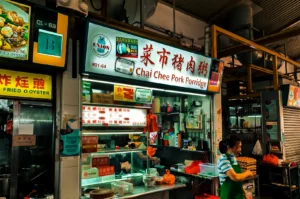
A Bowl That Only Makes Sense at Night: Chai Chee Pork Porridge at Bedok 85
Sarah Teh | October 8, 2026
The steam was the first thing I lost. It was well past midnight at Bedok 85, and I had been standing at Chai Chee Pork Porridge for a while, camera down, watching the auntie work the pot. She lifted the ladle, let the porridge fall back in a slow white ribbon, then lifted it again….
-
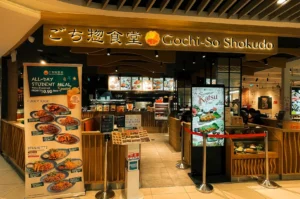
Gochi-So Shokudo: Discover This Japanese Comfort Food Spot For Your Night Food Crawl
Sarah Teh | October 7, 2026
Comfort food rarely announces itself. It waits in a mall corridor, somewhere between a shoe shop and an escalator, holding the smell of grilled pork and warm rice until you slow down enough to notice. That is where you find Gochi-So Shokudo ご, also known as ご ち 惣 食堂. Not a place chasing attention….
-
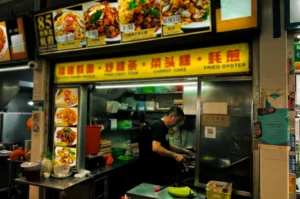
Oil, Oyster and Broken Light: Photographing Bedok North Fried Oyster at 1am
Sarah Teh | October 1, 2026
The first thing I noticed was the light. It was not the kind of light a photographer usually looks for. The fluorescent tubes above the stalls at 85 Fengshan Centre cast a pale, uneven glow across the tables, flattening some colours while exaggerating others. But at 1am, standing in front of the fried oyster stall…
-
When the City Goes Quiet, XO Minced Meat Noodles Begin
Sarah Teh | September 30, 2026
The last bus has gone. Newton Food Centre keeps a few lights on. I walk in past shuttered stalls, chairs stacked, floors still wet from a mop. Then I hear it: the scrape of a ladle, the low hiss of a pot. At 500 Clemenceau Ave N, #01-10, one stall is awake. XO Minced Meat…
-
Fire, Lime and Chicken Wings: A Night with Sin Bedok North BBQ
Sarah Teh | September 24, 2026
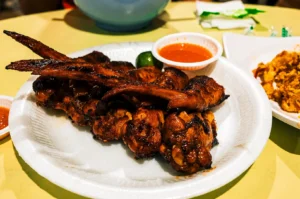
The wings went on before I found my angle. It was close to midnight at Bedok North, and I had been standing at Sin Bedok North BBQ for a while, camera down, watching the wings land on the grate in a neat row. The uncle laid them out without looking, the way you do a…
-
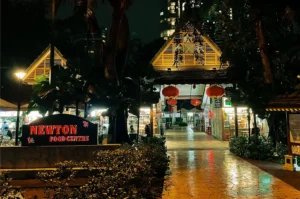
Newton Food Centre After Dark: The Stalls Worth Visiting at Night
Sarah Teh | September 23, 2026
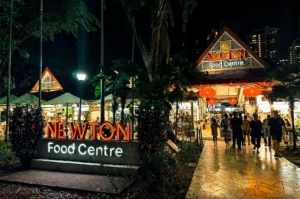
The day heat lifts slowly here. By the time I reach Newton Food Centre, the sun has gone and the light has changed hands. No longer the flat white of afternoon. Now it comes from the stalls themselves, bulb by bulb, a row of small fires holding back the dark along Clemenceau Avenue North. Newton…
-
The Red Glow of Chan BBQ: A Stingray Shoot After Supper Begins
Sarah Teh | September 17, 2026
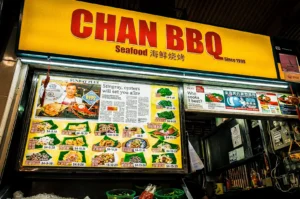
The grill was the brightest thing in the room, and that was the problem. It was past eleven at Fengshan Market & Food Centre, and I had been standing near Chan BBQ for a while, camera down, watching the uncle work the coals. He moved without hurry. A pair of tongs in one hand, a…
-
The Last Table at Keria Japanese Restaurant: A Late-Night Photoshoot in Cuppage Plaza
Sarah Teh | September 16, 2026
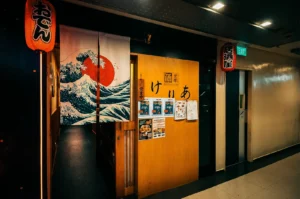
Orchard Road lets go of its crowds slowly. By the time I reached Cuppage Plaza B1 28, the shopping stretch behind me had thinned to a few late walkers and the low hum of traffic sliding past shuttered windows. The bright malls were already dimming. The night was settling in the way it does here,…
-
Sambal in the Shadows: Shooting Chomp Chomp BBQ at Bedok 85
Sarah Teh | September 10, 2026
The smoke found me before the food did. It was close to midnight at Bedok 85, and I had been standing at Chomp Chomp BBQ for a while, camera down, letting my eyes settle. The uncle worked the grill with his back half turned to the crowd, a pair of tongs in one hand, the…
-
Guzman y Gomez Singapore: When The Lights Stay On at Orchard Gateway
Sarah Teh | September 9, 2026
Orchard Road empties from the top down. By a quarter to midnight, storefronts have started pulling their shutters, glass gone dark over displays that glowed all day. Escalators still run. A few people drift toward the Somerset MRT with shopping bags softened at the handles, while red tail lights smear across the wet glass outside….